
The goal of this post:
- Explain why flexibility and choice created by multiple means is important in your classroom
Key ideas:
- By providing multiple means you are catering for diversity in learners, developing expert learners, being more present in lessons and allowing students to achieve success

Introduction
If you are an UDL fan like me, you’ll know that Universal Design for Learning is about providing choice and flexibility so that all students can be catered for. This is the best part about UDL!
The UDL Framework, created by CAST, encourages the use of choice to cater for the variability of learners. It is about providing multiple ways or opportunities for students to engage in and demonstrate their learning. Here are four big reasons why you should be using multiple means in your lessons.
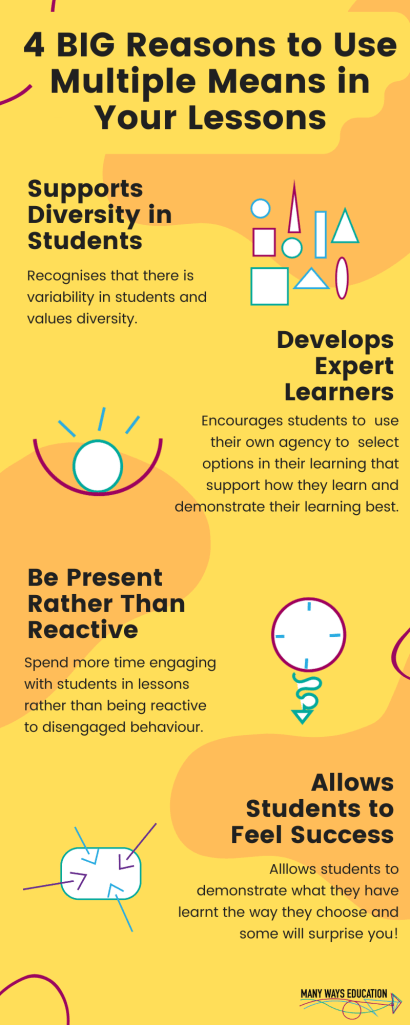
1. Supports Diversity in Students
Think of yourself as a learner. How many times have you been to professional learning and presenter talks at you the whole time and you find yourself frustrated? You are too busy thinking about how annoying it is to sit still and have to concentrate on their words when really all you want to do is talk about what you’re learning and applying it to real-world contexts. Whereas the person next to you might be loving the fact that they only need to sit and listen. Imagine that for students in our classes. It is not just the students with a disability that we’re supporting, when we provide multiple means, we are supporting a wider range of students. Multiple means recognises that there is variability in students and values that diversity.
2. Develops Expert Learners
By providing students with agency, we are giving them choice about what they or how they might want or even need to learn. In doing so, students learn what they need as learners and how they can best learn as well as how they best demonstrate their learning. Therefore providing opportunity for students to develop expertise in their own learning is developing expert learners.
3. Be Present Rather Than Reactive
This is my favourite as a teacher. By providing and pre-planning multiple ways for students, it allows us, as the teacher, to be present in the lesson rather than reactive. When we are present in the lesson, we’re able to engage and have robust conversations with students and as well as support the students who really need that extra support. The opposite of this is when we have one way and we usually find ourselves having to be reactive in responding to behaviours because students are disengaged.
4. Allows Student to Feel Success
Allowing students to demonstrate what they have learnt the way they choose might surprise us! That is what is magic about having students show us what we have taught them. By providing multiple means for demonstrating learning for students, they can select the way that will best suit them in showing us what they have learnt. Our students will feel successful!
Try This!
Providing options and choice in lessons can seem daunting but start small. The reality is that students need to learn how to make good choices when it comes to their learning especially when they have not had to make choices before. So you could start with something simple as having them choose if they work by themselves or with a partner. Student will most likely make the wrong choice to start with but what is important is to provide opportunity for students to reflect on their choices to determine if it was the right choice and if not, determine what they could do next time.
You could then move to how students demonstrate their understanding. This could look like drawing or recording their responses rather than writing. The possibilities are endless! What multiple means have you used in lessons lately?
 Many Ways Education
Leave a comment