
The goals of this post:
- Explain the difference between content and method standards
- Identify how to unwrap the standard to start to determine the goals of lessons
Key ideas:
- There are two types of standards in the curriculum
- Unwrap the standard to identify the skills and concepts required
- Use other areas of the curriculum to identify and clarify expectations in your context
The Standards and Universal Design for Learning
One of the misconceptions of UDL is that standards and expectations are kept low for all students to achieve success. However, is it really success if students are not achieving year level expectations? In fact, Katie Novak (2016) says it best; it is not a privilege to have access to year level curriculum but a right. UDL is a standards-based lesson design process (Novak, 2016; Posey & Novak, 2020). Standards need to be kept high and as a teacher, it is about having a UDL mindset. Therefore believing that all students can achieve the year level expectations because, as teachers, we have made conscious efforts to provide choice and removed barriers for students to achieve or exceed the standard.
Standards and Goals
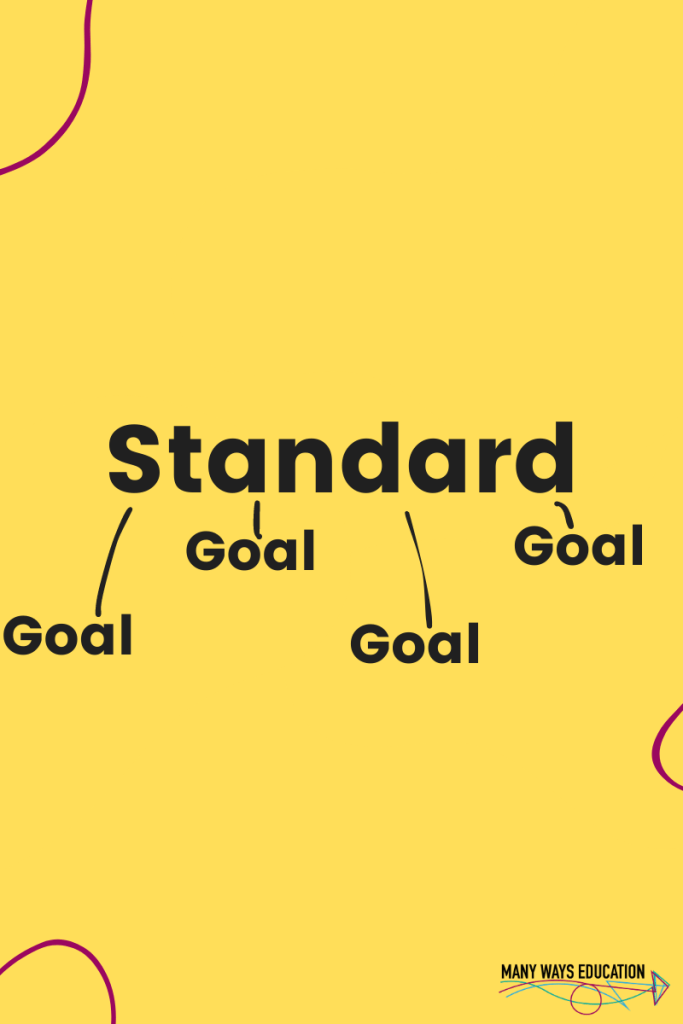
So, what’s the difference? The standard is the year level expectations of the curriculum. They are usually what is assessed in the curriculum. Goals are the smaller steps or lessons that support students in their learning to achieve the standards of the curriculum. You might have one standard and many goals that derive from the one standard depending on the skills and concepts within the standard as well as the needs of the students. It is also important to consider student strengths and weaknesses towards the standard when planning learning goals from the standard.
The Australian Curriculum
Here in Australia, we have a national curriculum called the Australian Curriculum. It is considered a three-dimensional curriculum and the learning areas are the foundation (ACARA, 2023). The learning areas include achievement standards (what is assessed) and content descriptions (what is taught). The content descriptions support the teaching that is required for students to achieve the achievement standards. They are interrelated. What is great about the Australian Curriculum is that it was created with UDL in mind (Evans, Humphreys & Gray, 2015). Therefore, the achievement standards are quite flexible in nature. This makes implementing option and choice within lessons and assessment a little easier. If you are not in Australia, I recommend getting to know how your curriculum was created and how it is structured. Has there been an inclusion focus from the start?
For the purpose of this post, I will be referring to achievement standards as standards.
Method and Content Standards
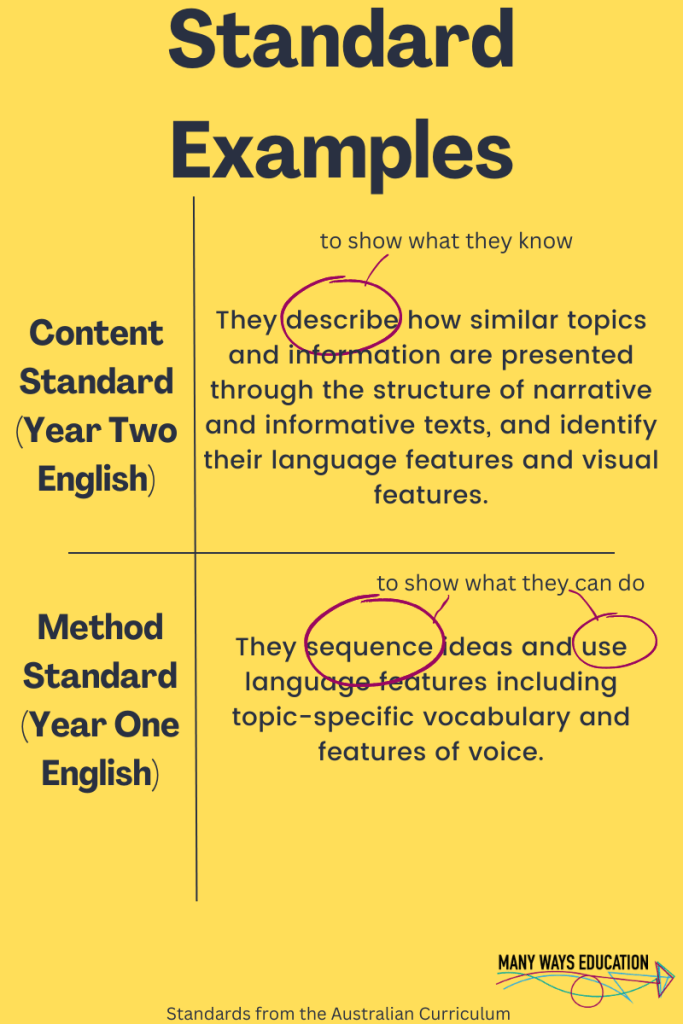
If you read through the standards within the curriculum, you will notice that each standard has a verb or in some cases a few verbs. When you look at the verb in each standard, you will notice that some verbs require students to do a skill while others require them to show they know a concept. Novak (2016), refers to these two types of standards as method standards and content standards.
Method Standard
Method standards refer to standards that require students to complete a task or skill. The verbs in these standards usually require steps or a process to demonstrate the standard. These are a little more restrictive in how students can demonstrate the standard however, the use of flexible supports or scaffolds could be used to support the student to achieve a method standard.
Content Standard
Content standards require students to internalise a concept or knowledge. These standards need students to demonstrate their knowledge of concepts. The verbs in these standards are usually tricker to demonstrate because they are more internalised for the student. However, content standards are more flexible and can allow students to demonstrate their knowledge in engaging ways.

It is important to understand what type of standard you are assessing to help you inform the types of methods, materials and assessments that could be used to ensure that all students can access the learning and demonstrate their learning against the standard.
Standards into Goals
From the standard, it is important to pull it apart to understand what the standard is expecting students to know and do. Rao and Meo (2016), suggest a process they call unwrapping the standard.
Unwrapping the Standard
To unwrap the standard, Rao and Meo (2016), identify four steps.
- Identify the skill required in the standard – this is identified by the verb in the statement
EXAMPLE
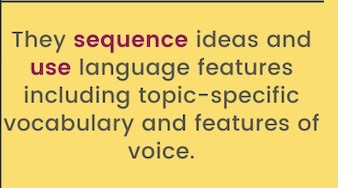
2. Identify the key concepts, knowledge or background knowledge needed to complete the skill – this is identified by the noun or descriptive phrases in the statement
EXAMPLE

3. Code the statement into skills and concepts
EXAMPLE
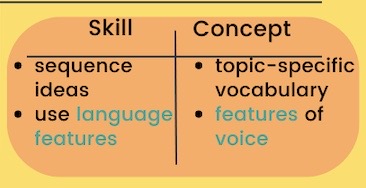
4. Develop a progression of lesson goals
Unpacking the Standard
You might discover in this process that there is more information needed. For the example above, the standard identifies language features as a concept, but what language features are required or appropriate for the year level? In this case, it is important to go to other areas of the curriculum and in the case of the Australian Curriculum, the content descriptions, year level description and elaboration can help.
Here I would add a step between three and four to Rao and Meo’s process to ensure that there is clarity of the year level expectations around the concepts and skills.
Here is the adapted version.

In the Australian Context
It is important to note that some states in Australia require schools to include marking guides, rubrics or criteria sheets to make on-balanced judgements against the achievement standards. Therefore when investigating the standards, it may be helpful to also consider the context in which they are being assessed in the task. If you have the opportunity to create your own marking guides/rubrics/criteria sheets, see if understanding the types of standards change or clarify how you might assess particular standards together.
Try This!
Next time you are investigating your curriculum standards, see if you can identify method and content standards. Identify how you might assess particular standards. Will they require scaffolds or how many ways could students demonstrate their learning that are engaging to the students?
Or you might like to unwrap the standards to identify the learning required for students to achieve the standard.
What process do you use to unpack the standards?

References
Australian Curriculum, Assessment and Reporting Authority (2023). Australian Curriculum Version 9.0.Retrieved from: https://v9.australiancurriculum.edu.au
Evans, D., Humphreys, S., & Gray, G. (2015). Australian national curriculum: applications of the principles of UDL. https://www.learningdesigned.org/sites/default/files/Evans_Humphreys_Gray_2015.pdf
Novak, K. (2016). UDL Now! A teacher’s guide to applying universal design for learning in today’s classroom. CAST, Inc.
Posey, A., & Novak, K. (2020). Unlearning Changing Your Beliefs and Your Classroom with UDL. CAST, Inc.
Rao, K., & Meo, G. (2016). Using universal design for learning to design standards-based lessons. Special Issue – Student Diversity, 1-12.
 Many Ways Education
Leave a comment