
Goals of the post:
- Identify useful ideas to support students in developing organisational skills
Key ideas:
- Limited working memory plays a role in enabling students to remember and organise information and resources
- Provide supports and aides to eliminate the barriers to working memory
Have you ever had a student who knew the content yesterday but can not remember a thing today? Or a student who seems to have their English work in their science workbook and vice versa? Think about how this impacts their engagement in the lesson and therefore their learning. So how do we support students with the organisation of information and resources?
Students need to have a variety of explicit models and scaffolds to help them develop strategies to manage information and resources. They need to practise using these strategies and scaffolds to work out which ones work for them. These strategies are difficult to master because they are internalised strategies that are not always explicit to observe and learn from others. Most of us have developed strategies over time that work for us and so students need the opportunity to do the same.
What the UDL Guidelines say
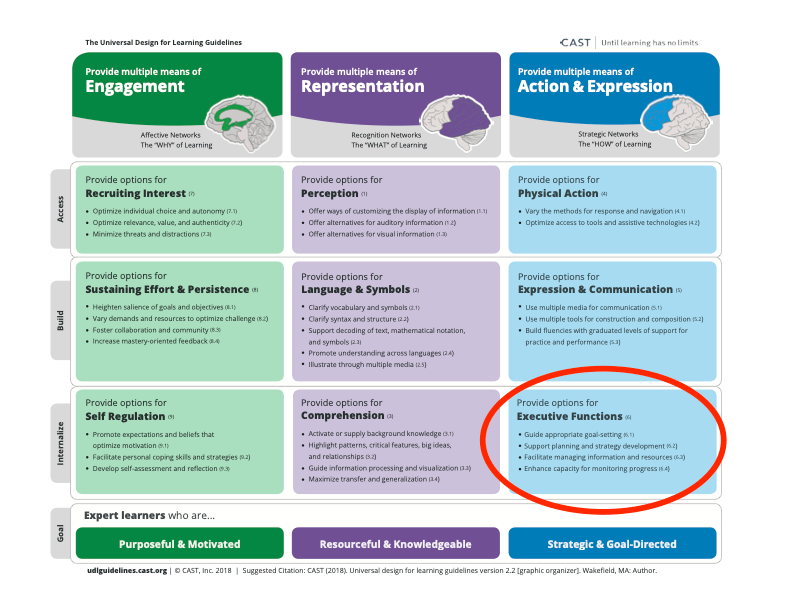
Luckily we have the UDL Guidelines to support us in considering how we can support these students so their organisation and forgetfulness is no longer a barrier for them. These skills sit under the guideline; Provide options for executive functions on the internalise row of the framework. It is easy to see just how tricky it can be for students to develop these skills because they are internalised in expert learners therefore not so obvious to see in others. But that does not mean they can’t be taught.
Working memory
Working memory is the big player in executive function and therefore developing organisational skills. Somethings to be aware of is that our working-memory is not unlimited. We only hold four to five chunks of information in our working-memory before we are overloaded. Working memory in learners with learning or cognitive disabilities can have even more limited working memory. It is important to consider if working memory is necessary for the lesson or can it be supported in the forms of scaffolds and aids (CAST, 2023).
Apply it to a lesson
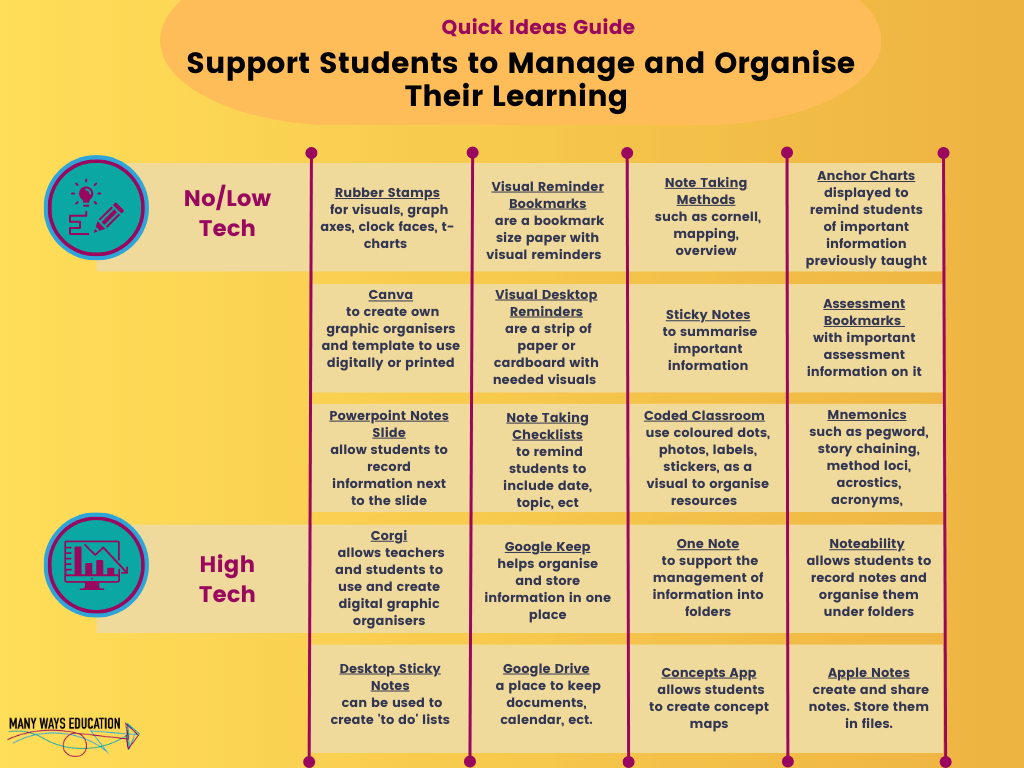
The job of our working memory is to determine if we should keep or throw away the information. Therefore it is important to consider just how much information we give in lessons. Too much information can cause our students to discard important information. We can support our students by breaking information into chucks where students have the opportunity to process the information. This can be done through the use of graphic organisers or templates that help students organise information. We can also help students be organised by providing prompts for categorising and systemising information and resources so they can access information they require for future lessons quickly. We can also explicitly teach students strategies and checklists for note-taking.
Quick ideas guide to support students to manage and organise their learning
Below are low/no tech and high tech ideas that could be implemented in any lesson.
Multiple ways
Remember not one strategy will fit all students so it is important to support students to identify strategies that work for them. Each scaffold, template, prompt, strategy or checklist needs to be explicitly taught and modelled for students. Students should have the opportunity to use them and then reflect on how helpful it was for them. Over time a new tool can be introduced and explicitly taught and added to the tool kit that students can access. In no time, students will have a choice of tools that can be used to help them manage and organise information and resources independently.
REFERENCES
Centre for Applied Special Technology. (2023). Facilitate managing information and resources. CAST. https://udlguidelines.cast.org/action-expression/executive-functions/information-resources/information-resources
 Many Ways Education
Leave a comment