
In this post you will find…
- Why it is important to make lessons relevant
- A process to make lessons relevant for your learners
- Examples of real world applications for five mathematical concepts
I Wonder…
What is the point of learning something? How many times have you heard the question: “Why are we learning this?” Or even worse, how many of our learners are playing the game of school without really understanding why education is important for their future and being lifelong learners?
What if learners were right to ask about the purpose of the learning they are involved in? What if that learner truly did not see the benefit of the learning because they did not see how it related to them and their goals?
Why Make it Relevant?
Once we have identified the goal of the lesson, derived from the standards, we need to identify how the goal is relevant to our learners. Relevance is identified in the UDL Guidelines under the Engagement Principle. Identifying the relevance of learning improves a learner’s intrinsic motivation to learn the content (CAST, 2018). When learners understand how the goal of the lesson is relevant to their lives or goals, they are more likely to be engaged in that learning.
However, it is important that we just don’t find the real world application for the goal, but how the goal is relevant to our learners and their lives and goals. So how do we do that?
Finding the Relevance in Lessons in Three Easy Steps
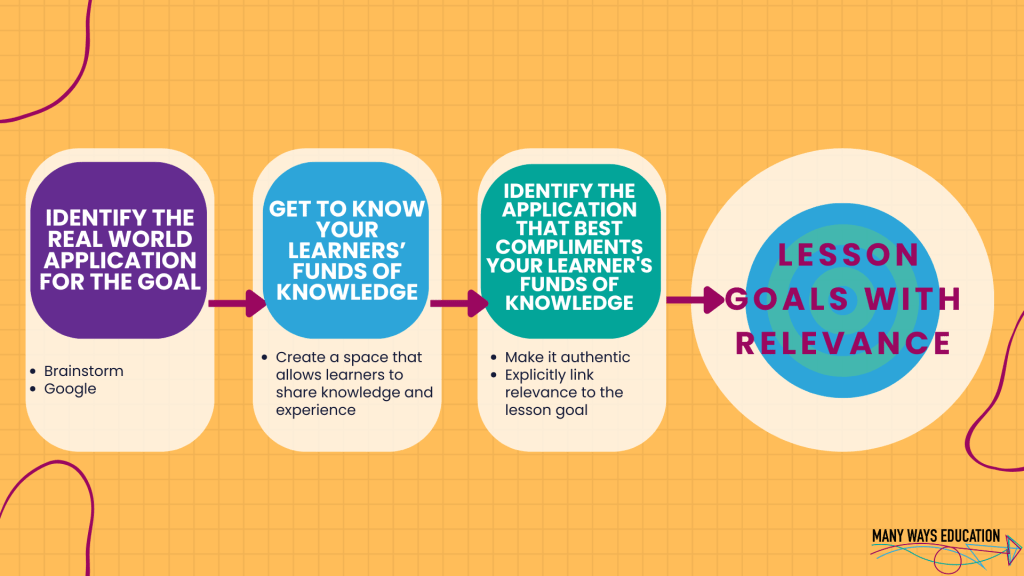
1. Identify the real world application for the goal
I find this step the most exciting for educators because this is where we can start to get the creative juices flowing with ideas of how the goal can be taught in authentic ways. This step is also more beneficial if there is a group of educators. For this step, it is really just about brainstorming how the concepts or skills in the goal can be applied to the real world. Why is this goal valued in our curriculum? It is a good idea to spend a little bit of time on this step and when we have run out of ideas ourselves, google it to see if there are any applications that we might have missed or not know about.
Here are some math concepts that I have brainstormed some real life applications for.
2. Get to know your learners’ funds of knowledge
It is important that we get to know our learners and not just as learners but as people with important and a vast variety of life experiences, values and goals.
Funds of Knowledge
Funds of knowledge was a concept developed by researchers who explored how educators could leverage aspects of learners’ home lives in the classroom. It derived from Culturally Responsive Teaching (Ralabate & Lord Nelson, 2017). Our culture influences how we see and interact with the world. Something that Ralabate and Lord Nelson (2017) point out is that culture is not just about ethnicity or race but any group with shared beliefs, values, practices and unspoken rules. This is really important to consider when we are identifying our learners’ culture. Funds of knowledge is about getting to know our learners as human beings that have immense life experiences outside the walls of the learning space. These experiences are what we can leverage and connect to when we are making lesson goals relevant. We can do this by creating a space that allows learners to share knowledge and experience.
3. Identify the application that best compliments your learner’s funds of knowledge
Once we have identified the application/s that relate to our learners, we can create lessons that are authentic to them. We can also explicitly link the relevance of the lesson to our learners in the lesson. This way our learners understand why the lesson is important to them and we don’t get the dreaded question: why are we learning this? The other thing to consider here is that there may be an opportunity to have multiple ways learners explore the real world application of the goal. Can there be options and choice as to how learners engage with the concepts and skills in the lesson goal?
So…
By making lessons relevant, we are activating the affective network of the brain for our learners. We’re also ensuring that our lessons are authentic for our learners. In doing so we are scaffolding for our learners what an expert learner does to be purposeful. This way our learners are not just playing the game of school.
What ways do you make lesson goals relevant for your learners?
Until next time,
Happy educating,
Sam
References
CAST, (2018). Universal Design for Learning Guidelines version 2.2. Retrieved from http://udlguidelines.cast.org
Ralabate, P., & Lord Nelson, L. (2017). Culturally Responsive Design for English Learners: The UDL Approach. CAST, Inc
 Many Ways Education
One thought on “Making Learning Relevant with UDL: How to Find the Relevance in Lesson Goals in 3 Easy Steps”