
In this post you will find…
- Key mindsets you need to design assessments for all learners
- A process to design assessments that are inclusive for all learners
- A link to a free webinar to design your own assessment tasks
Hand up if even the word “assessment” douses even the tiniest bit of anxiety. Whether you are an educator or learner this word causes most of us to have a niggle of anxiety. Have you ever thought about why that is?
For some of us assessment means struggle and frustration. While some of us see this in others. Assessment provokes feelings of sadness and helplessness. What if assessment did not have to be like this?
Unfortunately, for some of our learners, this is a regular occurrence. The thought of assessment causes them to shut down or try their hardest to only fail. It can be exacerbated when that learner is having success in the learning and then struggles with the assessment. So usually when we unpack this what we find is that we are so creative during the learning process to engage and ensure that learners have access to the learning, yet when we come to our assessment tasks, we give the same assessment task to every learner every year at the same time. What if we started designing assessment tasks to suit our learners and not the other way around?
Types of Assessment
So firstly, let’s talk about assessment. assessment is an integral part of any teaching and learning cycle regardless of if it is formative assessment or summative assessment. Sometimes we need to assess at the end of the unit to identify what our students have learned during the unit and other times we need to track or monitor how they’re going throughout the unit or at the end of a lesson to gauge how well they have retained or understood the content that we taught them. So let’s unpack.
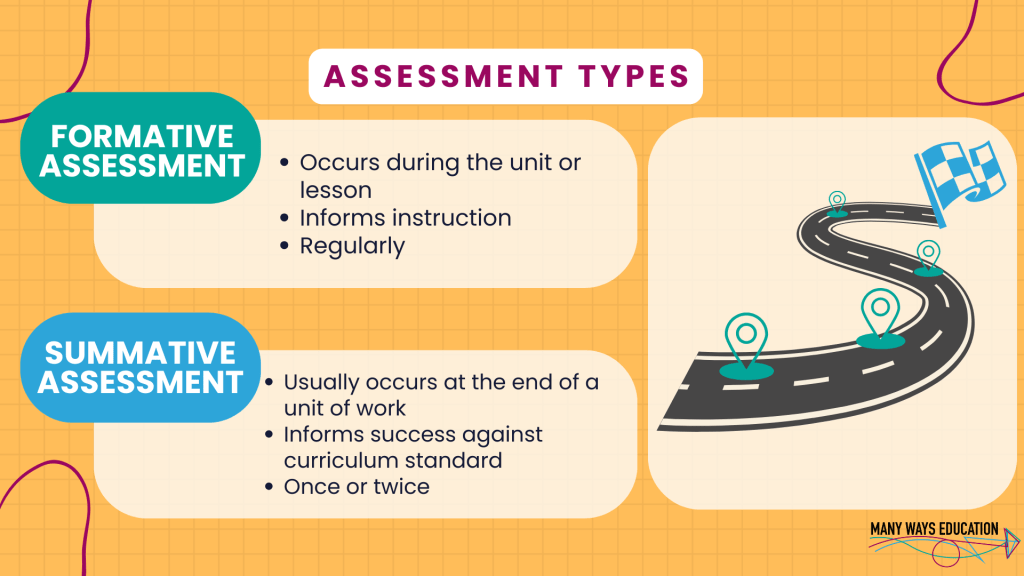
Formative Assessment
Formative assessment is throughout the unit and it’s typically pretty much every lesson. We have some form of formative assessment to gauge how our students have understood or learnt the content that we have taught within that lesson. Think of formative assessment as the check points on a journey to a destination.
Summative Assessment
Summative assessment is usually completed at the end of a unit of work to gauge how our learners have gone and whether they have understood the content within the unit. It is the final destination.
Regardless of the type of assessment we are implementing, we can use a UDL lens over that assessment task to ensure that our learners do have the best possible chance to demonstrate what they know.
A UDL Mindset in Assessment
When we put a UDL lens over our assessment, we need to then consider how our assessment tasks, regardless of whether they are formative or summative, are assessing the construct we are intending to assess. The construct is what we want to collect information on. It can be the skill or the understanding our learners need to demonstrate. At times, the design of assessment tasks can impact a learner’s ability to demonstrate the construct of the assessment. To ensure our assessments are construct relevant, we can use a UDL lens on our assessments.
A UDL Lens Invites Us to:
Acknowledge Variability in Our Learners
Variability is the norm not the exception. When we acknowledge variability in our learners, we can design assessment that allows more learners to succeed from the very start.
Design to Eliminate Barriers for Learners
Barriers create construct irrelevant assessment tasks. By removing barriers from assessment we are ensuring that we are assessing the construct we need to assess therefore increasing the reliability of the data being collected (Ketterlin-Geller, 2005).
Provide Multiple Means
Providing multiple means within assessment acknowledges that no two learners are the same. This means that one way will not support all our learners to have the best opportunity to demonstrate their learning in a way that best supports their strengths.
Promote Expert Learning
Through choice we are promoting expert learning. When our learners have the opportunity to take control of their learning, through choice, they are developing the skills required to become expert learners.
Keep Expectations High
The construct of assessment should come from the curriculum standard itself. Therefore we need to ensure that the task is designed so that learners demonstrate their learning at the same level required by the curriculum. We use strategies to bring learners up to the expectations.
When we use a UDL lens over assessment our thinking changes about the design of the assessment task. Here is a process I use to design assessment that is inclusive for all learners.
A Process for Design

1. The Construct Being Assessed
Firstly, we need to ensure that we are keeping the integrity of the curriculum and we need to unpack the construct that we are trying to assess. If you’d like to know more about construct relevant assessment, have a look at this video from CAST about what construct relevance is. When we are identifying the construct we need to gauge what are the limitations and expectations of the construct. To do this, we need to unpack the curriculum standard and any supporting resources the curriculum provides because our construct should be coming from the curriculum. We need to look at the verb which is typically the skill that learners need to demonstrate, and then we need to look at the concepts around it or the way learners need to demonstrate that skill. So we need to unpack the standard to help really clarify what the construct is or what we are assessing. This is a great step to do with other educators to develop a shared understanding of the construct. Another tip is to look at the curriculum below and the curriculum above the year level to understand what was expected before and after. Once we have clarity around the construct being assessed, then we can actually move to who is being assessed.
2. The Learners Being Assessed
So now we need to consider the learners that are being assessed. Typically in a traditional classroom, we use the same assessment task year after year regardless of our learners, but when we put a UDL lens on our assessments, we need to think about our learners in front of us this year. Every time we need to consider what are the barriers that our learners this year may come across in completing this assessment task and we can do that by reviewing what it has occurred in past assessments, and ask:
- What was challenging for our learners? What were the barriers and could those barriers be removed because they were actually barriers to learners demonstrating their understanding of the construct in the assessment?
- Can we ask our learners what they found challenging in past assessment tasks?
- What have we been doing in our units of work to eliminate barriers for our learners and can we apply those strategies to our assessment tasks?
- How is this construct relevant to our learners and can we then create tasks that are based around that relevance so that the task is authentic for our learners?
3. The Task Design
We can now bring everything together in the design of the assessment task. The design of the task should reflect our understanding of the construct being assessed and our learners. Once we have designed the task, ask:
- How are we ensuring that we are eliminating barriers? (Consider format, layout, sequence, structure, language, ect.)
- Are we supporting expert learners through choice?
- How is this task relevant to our learners?
Helpful hint: Complete the task yourself and put yourself in your learners’ shoes or better yet ask someone else to complete the task and ask them about their experience. Also check here that the task does assess the construct.
Want to investigate this more or go through the process with someone? Try out my first ever free webinar on designing inclusive assessment tasks for all learners click here.
As educators we work so hard to ensure that our learners understand and apply what they have learned; however it can be discouraging when it comes to assessment. We have all experienced learners who are disengaged or fail tasks we know they understand in a different context. What if the task is the barrier to demonstrate their understanding? We should always reflect on why we achieved those outcomes to ensure we are giving our learners the best chance of success. How do you ensure that your learners have the best opportunities to show what they know in assessment? Comment below.
Until next time,
Happy educating,
Sam
References
Ketterlin-Geller, L. (2005). Knowing what all students know: Procedures for developing universal design for assessment. Journal of Technology, Learning, and Assessment, 4(2). Available from http://www.jtla.org
 Many Ways Education
One thought on “Breaking Down Barriers: An Inclusive Approach to Designing Assessment for All Learners”