
In this post, you will find…
- 5 practices you should be doing with your formative assessment
- 5 tips to support the implementation of those practices
- Free printable learner progress tracker!
Formative Assessment
When you think of formative assessment, do you think of it as an exit ticket at the end of a lesson or the checking for understanding throughout the lesson? No matter what you think of when you think of formative assessment, formative assessment should be in every learning experience (CAST, 2020, Fisher, et al., 2019). Effective formative assessment can improve engagement. When learners are aware that formative assessment aligns to the learning goal they are more likely to engage in the activity. When that activity provides feedback to learners on how they are progressing towards the goal learner engagement improves (Knight, 2013).
When we plan using elements of a UDL lesson, formative assessment is at the forefront of designing the learning experience. But formative assessment should not just be a task that learners do during a lesson. It doesn’t just stop there. In order for formative assessment to be effective, we need to implement practices that allow us to inform our teaching, monitor learner progress towards a goal, provide feedback and offer choice for our learners.
5 Practices You Should be Doing with Your Formative Assessment
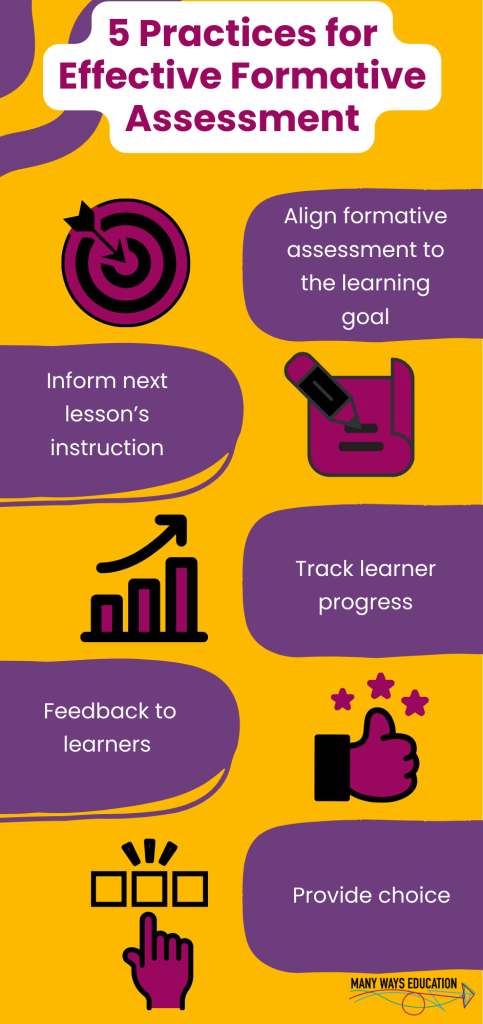
Aligning Formative Assessment to the Learning Goal
What good is formative assessment if it does not measure what we want it to measure? Good formative assessment ensures that it is assessing learners’ proficiencies towards the learning goal. Without clear alignment, we can not use the data collected to inform our instruction, identify learner progress or provide effective feedback towards the goal.
Tip
A good strategy is to brainstorm how learners could demonstrate their learning of the skills and the concepts in the learning goal. Then select the ideas that best suit your learners and context. You then can select a few options depending on your and your learner’s confidence levels.
Inform Next Lesson’s Instruction
One of the main purposes for formative assessment is that it should be informing the next lesson’s instruction. We use formative assessment to identify how learners have understood or achieved the learning goal and then make decisions about what the next lesson will be and what instruction we will provide. It can also give us great insight into if the instruction, options and supports we provided in the current lesson have had a positive impact on learners. Another consideration is if the formative assessment choices have allowed learners to demonstrate their skills or understandings or if the task has unintended barriers. All of this information should inform how we will go about the next lesson.
Tip
If making adjustments to lessons based on every learner’s assessment feels overwhelming, a great first step could be to identify three focus learners that you could use to identify the impact of your teaching on. Then use the information you identify in their work to inform your next lesson.
Track Learner Progress
The results learners receive on summative assessment should not be a big surprise when formative assessment is used to track the trajectory of learners towards the summative assessment (Fisher, et al., 2019) . Formative assessment should be used to gauge how learners are progressing towards the learning goal.
Tip
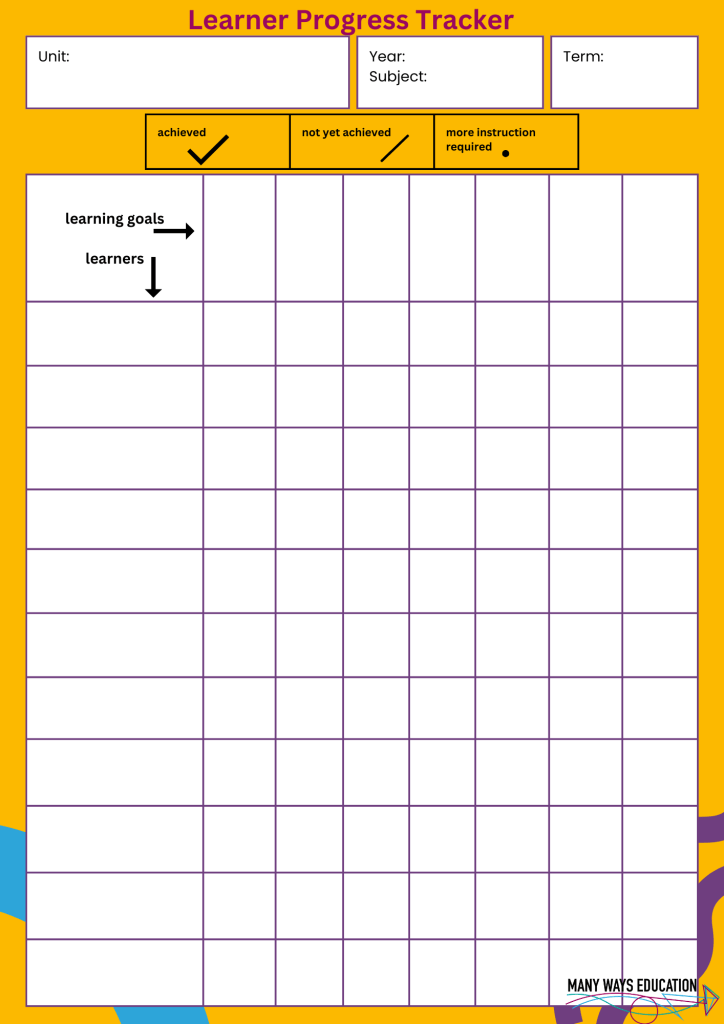
Make a table with the learning goals of a unit and code learners for achieved, not yet and more needed. This is a visual way to see how learners are traveling throughout a unit. This can also inform your instruction for the next lesson. Download an example tracker below.
Feedback to Learners
All learners should know how they are progressing towards a goal. Formative assessment is a great tool to facilitate feedback to learners. By providing timely and frequent feedback on how learners are going and how they could improve we are promoting expert learners. This also supports engagement. When learning activities provide helpful feedback on how to progress towards mastery of the goal, learner engagement improves (Knight, 2013).
Tip
Feedback does not need to be written. In fac,t if we think about feedback through a UDL lens, we could consider providing feedback orally (face-to-face, voice memo), in workshop form, showing worked examples or showing visual representations of how to use a tool or strategy. There are many ways to provide feedback but we know that effective feedback needs to be frequent and timely for our learners.
Provide Choice
When we provide choice in formative assessment we are acknowledging learner variability and eliminating barriers. Choice also supports engagement and builds confidence in our learners (Torres & Rao, 2019) because we are allowing learners to play to their strengths. When we allow learners to make choices about how they will demonstrate their understanding, we are also promoting expert learning (CAST, 2020).
Tip
Start with the learning goal and brainstorm all the ways learners could demonstrate their learning towards the goal. This is more effective if it is done with other teachers. Consider the ideas that are relevant to the learners. Remember relevant and authentic options engage learners.

Therefore…
For us to unlock the potential of our learners, we need to ensure that we are using formative assessment effectively. By making sure we are implementing these simple practices our learners can achieve greater success in their learning and that is what we are here for.
What tips do you suggest when implementing formative assessment?
Until next time,
Happy educating,
Sam
References
CAST. (2020). Tips for Assessment. Retrieved from: https://www.cast.org/binaries/content/assets/common
Fisher, D., Frey, N., Amador, O., & Assof, J., (2019). The Teacher Clarity Playbook: A Hands On Guide to Creating Learning Intentions and Success Criteria for Organised, Effective Instruction. Corwin
Knight, J. (2013). High-Impact Instruction: A framework for great teaching. Corwin
Torres, C., & Rao, K. (2019). UDL For Language Learners. CAST. Inc
 Many Ways Education