
In this post you will find:
- How to make assessment authentic for learners
- Narrative assessment task ideas
How many times have we used assessment tasks that require our learners to put in a lot of effort into assessments that are not meaningful, relevant or even engaging? We seem to assess high cognitive load skills in mundane tasks and wonder why our learners just focus on getting the task done with as little effort required as possible. Think about the tasks that learners find authentic. They will spend more time and work more diligently to develop high quality work when they find the assessment relevant and meaningful.
It is important that when we are designing assessment tasks, we are eliminating the barrier of irrelevance. When we engage the engagement network of the brain we are ensuring that learners are motivated and connected to their learning (CAST, 2020). So why is it any different for assessment?
Making Authentic Assessment Tasks
To make assessments authentic, it is important that we understand our learners’ funds of knowledge (Torres & Rao, 2019). Funds of knowledge are like backpacks that all learners come to school with. They are the experiences, knowledge and skills learners will come to the learning with. Every learner has one and our job is to get to know their funds of knowledge so we can tap into them to make learning and assessment more engaging. It is also important to note that our learners’ funds of knowledge may not be the same as our own because of cultural and societal differences in some contexts. But this is what makes funds of knowledge such an exciting concept because everyone (including the educator) can learn something new or different to what they normally are exposed to.
Authentic Narratives
Narratives are all about sharing experiences of the human condition and what better way to promote that through relevant assessments that allow learners to share their stories with their peers, the school community and the world!
Narrative
When referring to a narrative, I am referring to a narrative defined by the Australian Curriculum as; “The selection and sequencing of events or experiences, real or imagined, to tell a story to entertain, engage, inform and extend imagination, typically using an orientation, complication and resolution.” (Australian Curriculum, Assessment and Reporting Authority, 2023)
Therefore these ideas focus on assessing the structure and elements of a narrative. Some ideas will play themselves to other aspects of the standards such as handwriting or spelling but some might not. This is not an extensive list but a good place to start.
Just a Few Notes
- It is important that as a teaching team, decisions are made about how these ideas are implemented and assessed in your context. Also make sure you refer to the standards you are assessing when designing the assessment task using these ideas.
- It is also important to note that in the Australian Curriculum texts are referred to as all forms of augmentative and alternative communication meaning they can include gesture, signing, real objects, photographs, pictographs, pictograms and Braille (Australian Curriculum, Assessment and Reporting Authority, 2023).
Ideas
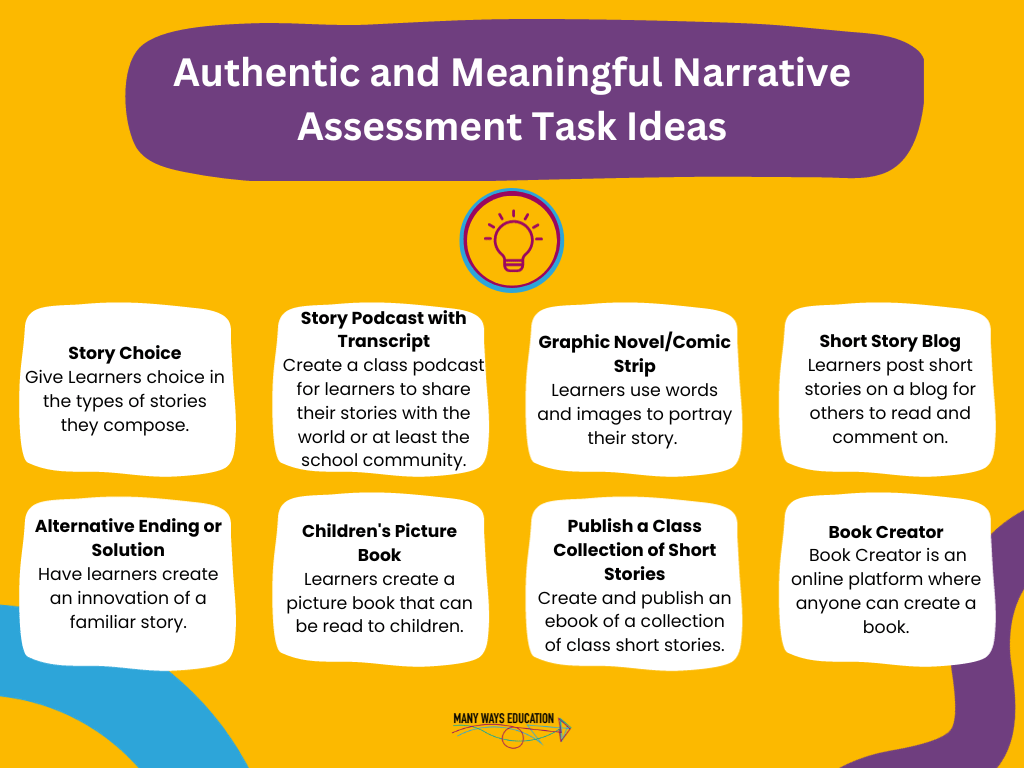
Story Choice
Give learners choice in what they create stories about. Some learners might want to tell stories about their own lives or some might be interested in sci-fi. Give them choice in the types of stories they compose.
Story Podcast with Transcript
Create a class podcast for learners to share their stories with the world or at least the school community. Each learner can record their story that can be shared with others and families. Have learners write the transcript before recording to assess spelling, punctuation etc.
Graphic Novel/Comic Strip
Learners use words and images to portray their story. A great way to explore character development. There are also some great tools on the internet that can support learners to create images for those who are not artistic.
Short Story Blog
Create a class story blog. The class posts short stories on a blog for others to read and comment on.
Alternative Ending or Solution
Have learners create an innovation of a familiar story. Great for learners who find generating ideas difficult. They could change the problem or the solution of the story. They could also change the types of characters.
Children’s Picture Book
Learners create a picture book that can be read to children. A great way to engage the school community is to have learners create stories for other learners or their peers. The picture books could be displayed and celebrated in the school library.
Publish a Class Collection of Short Stories
Create and publish an ebook of a collection of class short stories that learners can take home and share with their families. These stories could be emailed home for families to see the great work their learners have done.
Book Creator
Learners can let their creative juices run wild by creating multimodal stories that really engage their audience. Book Creator is an online platform where anyone can create a book. These books can include text to speech, images and gifs to engage the reader. Learners can share and read others’ creations.
What other ways do you assess narrative in authentic and meaningful ways?
Until next time,
Happy educating,
Sam
References
Australian Curriculum, Assessment and Reporting Authority, (2023). English Glossary.
Australian Curriculum, Assessment and Reporting Authority, (2023). Understanding This Learning Area. https://v9.australiancurriculum.edu.au/teacher-resources/understand-this-learning-area/english
Centre for Applied Special Technology. (2020). UDL Tips for Designing Learning Experiences. Wakefield, MA: Author. Retrieved from https://www.cast.org/binaries/content/assets/common/publications/downloads/cast-udltipsfordesigninglearningexperiences-20200920-a11y.pdf
Torres, C., & Rao, K. (2019). UDL For Language Learners. CAST. Inc
 Many Ways Education
Leave a comment