
In this post you will find:
- A process to reflect on assessment tasks for accessibility
It’s the beginning of the school year here in Australia and what a good time to reflect on upcoming assessment tasks before you dive into unit planning. If you’re lucky enough to have assessment tasks already created well this post is for you. If you haven’t you might like to over and read this post about designing inclusive assessment tasks.
Regardless of the type of assessment, we need to consider how accessible our tasks are for our learners. We need to consider accessibility and the removal of barriers to ensure that what we are intending to assess is what we are actually assessing.
Consider Accessibility
When assessment tasks are designed with barriers, accessibility for a lot of our learners decreases. One way to think about it is that we are not getting the true understanding of our learners when there are barriers built into the assessment task. This is called construct irrelevance. Construct irrelevance is when the task does not assess what it is intended to (CAST, 2020). For example in math we can provide a booklet of word problems that learners are to solve, however what the task is actually assessing is the learners ability to read the word problems. The barrier is in the design of the task. Whereas if we were to take those same word problems into smaller chunks to support cognitive load and provide a text to speech tool or the teacher read the problems to them, the barrier would be eliminated and we would have a true understanding of the learners ability to solve those problems and not whether they can focus for long enough and read the problems. We always have the best intentions in our assessments to ensure that we are providing opportunities for our learners to demonstrate their learning but something in the very nature of how we want learners to demonstrate their learning can be the barrier.
Overcoming The Barrier
The best way we can overcome barriers in the design of assessment tasks is to provide choice. For example in the math problems, learners could have the choice to access the speech to text options, have the teacher read the problem or do the task independently. This way we are providing options that cater for as many learners as possible.
We can also provide scaffolds. Now we do need to be careful that we are not hand feeding the answers but we can provide tools and resources to help support learners in the comprehension of the task by providing visuals, graphic organisers or vocabulary definitions. We can also support learners in the completion of the task by providing checklists, graphic organisers, prompt sheets, ect. The list is endless.
How Do I Know If I Have Barriers?
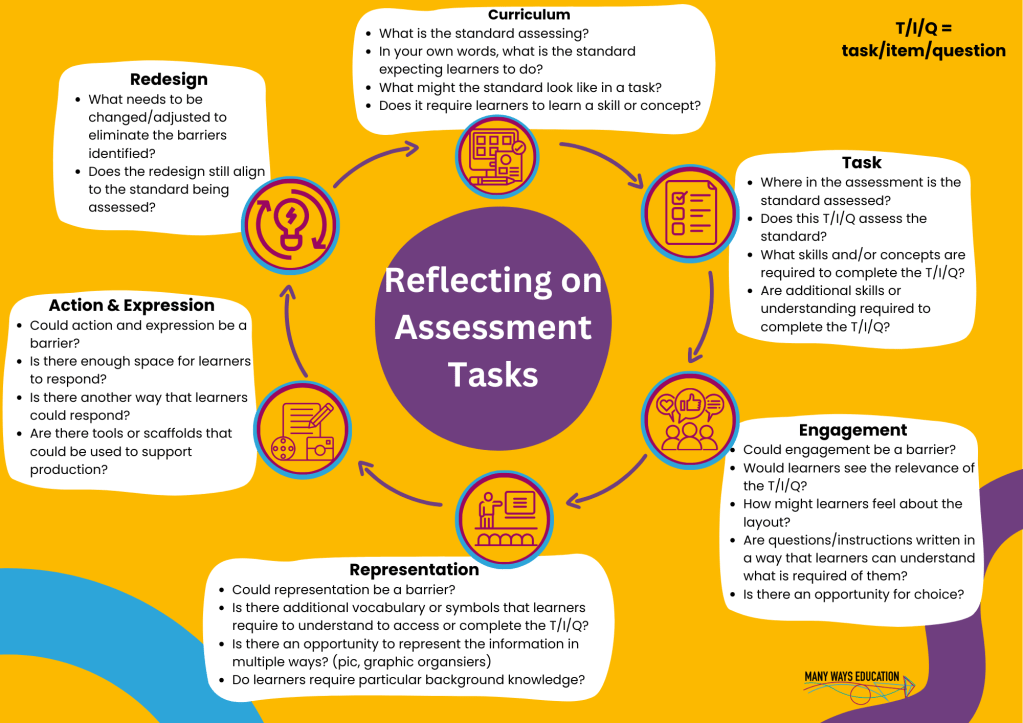
There are a few simple steps we can go through when we have designed an assessment task to help identify any unintended barriers. Now it is important to remember that there is no way we can eliminate all barriers. The goal is to continually reflect and refine over time. This will also be influenced by our learners from one year to the next. Have a read of the graphic below to see if you have barriers in your assessment. You can also download and share with your teams.
Until next time,
Happy educating,
Sam
 Many Ways Education
Leave a comment