
In this post you will find:
- What big ideas are
- How they can contribute to providing flexibility and relevance in learning
The big ideas are the missing link between the actual curriculum and the enacted curriculum in the classroom. How many planning sessions have you been to where the big ideas are discussed? We tend to identify the skills and concepts learners are required to achieve the curriculum standard but very rarely do we discuss what the big ideas of the unit are and how those skills and concepts align to them.
What do we mean by a big idea?
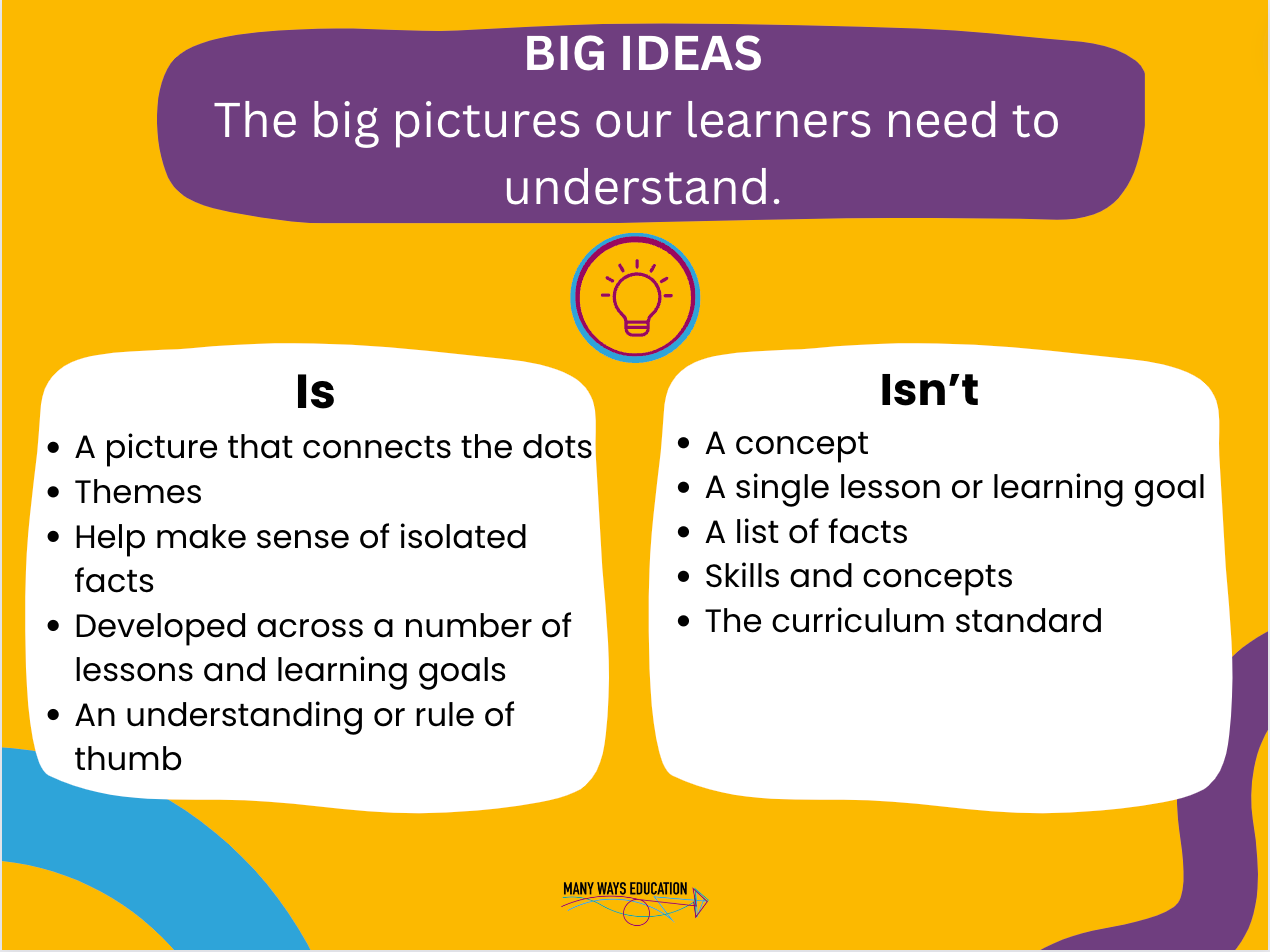
Big ideas give us real clarity of what we need to teach and why we need to teach it. The big ideas within learning areas, units of work and learning experiences are the big pictures our learners need to understand for the real world. They are the pictures that connect the dots (Wiggin, 2010) of skills and concepts described in the curriculum. These ideas are developed across a number of learning experiences and learning goals (Wiggins, 2010) and grow in depth and complexity over time (Siemon, 2022).
These big ideas come from the curriculum standards but are not the curriculum standards. They are the key themes within a learning area, unit or learning experience that learners need to understand in order to be successful in the learning as well as for life.
What is flexibility?
When there is flexibility in the ways learners can access the learning it empowers them to make choices that support them as learners (CAST, 2020). Educators can create flexibility in the goals of the learning experience or through the methods and materials learners engage with throughout the learning experience. Flexibility is not letting learners choose what they want and it does not mean that we lower the expectation. On the contrary, it is about keeping the expectation of the curriculum high and providing flexibility in the means in which learners use to achieve the goal of the curriculum.
How can we demonstrate flexibility?
Flexibility can be demonstrated through the learning goal of the learning experience as well as the methods or materials learners engage with to develop skills and concepts. Flexibility can be demonstrated through learning goals, assessment , methods and materials. We provide flexibility through the means of these elements.
How do big ideas from the standard support flexibility?
We can focus on what we want learners to truly understand, it provides space for us to design choices that allow learners to demonstrate that understanding. When we consider the big ideas in a unit of work or learning experience we allow for flexibility.
The big ideas are the themes or pictures learners are required to understand. They do not explicitly state the skills and concepts learners are required to demonstrate in order to understand the big idea, therefore providing flexibility in a way learners explore and engage in the big ideas of a unit of work. We as educators can provide flexibility in the way we unpack and explore those themes with our learners.
Big ideas allow us to provide flexible learning goal options because it allows us to see the bigger picture of what learners need to understand and demonstrate. We can have multiple learning goals structured at different levels or broader learning goals that allow learners to explore and engage in the themes and concepts of the unit in different ways.
What is relevance?
Relevance starts with the learner. What is relevant to one group of learners is not relevant to another. When learners understand the relevance of a task they are more likely to engage with the task (CAST, 2020). It is important that we ensure that what learners are learning has real-world application.
How can we demonstrate relevance?
We can demonstrate relevance through the very design of the learning experience by providing real world problems or tasks for learners to solve or achieve. Relevance can be simply stated at the beginning of a learning experience or a real world stimulus could be provided for learners to ponder before or during the learning experience.
How do big ideas from the standard support relevance?
Big ideas should be relative to the real world that is why they are not just the curriculum standard. It is important to consider how these big ideas transfer to the real world (Wiggins, 2010). It is in their very nature of big ideas to be the real world themes that we want learners to know and understand. Once we understand those big ideas we can then show our learners how those big ideas apply in the real world and how they apply in the learner’s world.
How do big ideas support flexibility and relevance?
By simply understanding the big ideas, we have a deeper and clearer understanding of what our learners need to know. If we have a deeper and clearer understanding of what our learners need to know we can provide flexibility and relevance for all our learners because big ideas can be transferred across contexts and modes. They are flexible and relevant in nature because they are the big pictures learners need to know to engage in the world around them.
Next time you are planning a unit or even a learning experience, consider the big idea you are trying to portray to your learners and see if it brings clarity in how you can provide flexible and relevant means to your learners.
Until next time,
Happy educating,
Sam
References
Alleman, J., Knighton, B., & Brophy, J. (2010). Structuring the Curriculum Around Big Ideas. Social Studies and the Young Learner, 23 (2). 25-29. https://www.socialstudies.org/system/files/publications/articles/yl_230225.pdf
CAST (2020). UDL Tips for Designing Learning Experiences. Wakefield, MA: Author. Retrieved from https://www.cast.org/products-services/resources/2020/udl-tips-designing-learning-experiences
CAST (2020). UDL Tips for Developing Learning Goals. Wakefield, MA: Author. Retrieved from https://www.cast.org/products-services/resources/2020/udl-tips-developing-learning-goals
Centre For Teaching and Learning. Big Ideas. Centre for Teaching and Learning. https://ctl.uaf.edu/big-ideas/#:~:text=The%20term%20%E2%80%9Cbig%20ideas%E2%80%9D%20comes,as%20the%20linchpin%20of%20understanding
Siemon, D. (2022). Teaching with the big ideas in mathematics. Mathematic Teaching Toolkit. https://www.education.vic.gov.au/Documents/school/teachers/teachingresources/discipline/maths/teaching-with-the-big-ideas-in-mathematics.pdf
Wiggins, G. (2010). What is a “big idea”?. Authentic Education, https://authenticeducation.org/whatisabigidea/
 Many Ways Education
Leave a comment