
In this post you will read about:
- What the one minute pause is
- How it aligns to the UDL Guidelines
- An example of it in practice

When we talk about learning experiences that include UDL principles, we are talking about providing multiple means for learners to access, engage and demonstrate their learning. However when starting on this journey that can feel overwhelming and unachievable.
A strategy that is talked a lot about in professional learning for UDL is the notion of plus one (Pusater, 2022). This means that as educators, the intention is to not overhaul our pedagogy to implement UDL but just make small changes over time. In this series we are going to provide examples of small routines that demonstrate the UDL principles and that could easily be implemented in learning spaces tomorrow. So let’s take a look at the one minute pause routine.
One Minute Pause Routine
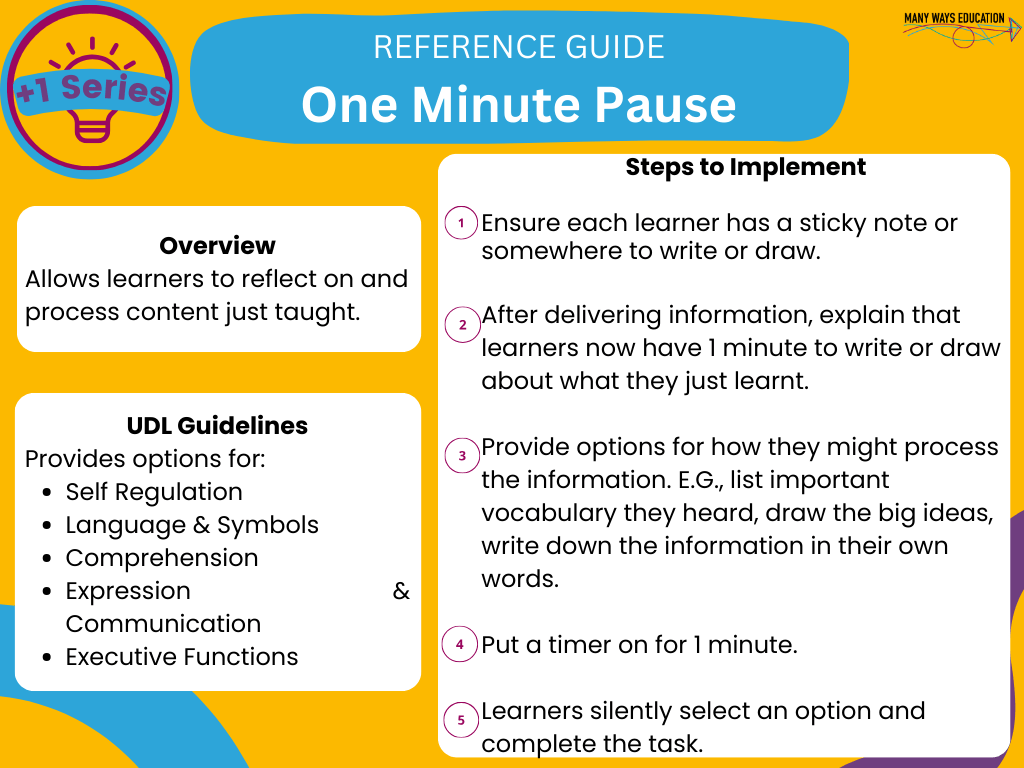
One minute pause is a routine that allows learners time to reflect and process the learning that has just occurred. This allows learners to deepen their understanding of the topic just learned (Stein, 2024). This routine is referred to by Elizabeth Stein (2024), as a strategy that teaches within the spaces of teaching. Meaning that this routine can be used as a quiet transition that allows time for learners to quietly reflect and process what they have just been taught. This is a great routine for transitions because it also minimises wait time for learners.
How it Aligns to the Guidelines
Self Regulation
One minute pause allows learners to reflect and evaluate their understanding of the topic taught. This supports self- assessment and reflection as well as a motivation to focus on the learning during the learning experience.
Language and Symbols
Vocabulary and symbols can be clarified through the use of this routine as well as connecting new learning to previously taught. Learners are able to process new language and structures in a way that supports their own understanding.
Comprehension
One minute pause allows multiple opportunities to use “information processing skills” (CAST, 2024). This routine is a great way to connect new learning to big ideas or prior knowledge and review information .
Expression and Communication
By providing choice in a one minute pause, learners can communicate their understanding of the content in a way that supports their learning. This is just one small and simple way that learners can demonstrate their learning.
Executive Functions
This routine enables learners to self-assess and reflect on their understanding. Learners can review the information taught and reflect on how well they have understood the content.
An Example
This routine can be used in any learning experience. It is best used after a small chunk of information has been delivered and the learning experience is transitioning in some way.
The options that you provide can vary depending on the content you are teaching or your learners ability to understand what the options are asking of them. Remember each option needs to be taught prior to being an option so that it does not become the barrier to completing the one minute pause.
Year Three Verb Learning Experience Example
After activating prior knowledge for what a verb is, a one minute pause is used for learners to reflect on and process their understanding of what a verb is. The options for reflecting and processing include; list the important vocabulary you just heard, draw an example or write about what a verb is. Learners have one minute to select an option and complete it on a sticky note provided to them. As the class moves through the learning experience about sorting verbs into their types (action, sensing, saying, relating), after the guided instruction, learners are provided another opportunity to list the important words they heard, draw an example of each verb type or write about the verb types. Learners have another minute to select and complete their option.
For younger learners, it is important that you provide specifics on the options so you don’t get random thoughts from the learners. However to keep consistency keep the same verbs in the options to minimise cognitive load for learners. Remember they only have one minute and the focus needs to be on them reflecting and processing what they have learned in the learning experience.
Next time you have a transition in your learning experience, have a go at a one minute pause routine. Start small by modelling one or two options then add the third over time.
Until next time,
Happy educating
Sam
References
CAST. (2024). UDL: Comprehension. The UDL Guidelines. Retrieved March 14, 2024, from https://udlguidelines.cast.org/representation/comprehension
Pusateri, J. L. (2022). Transform Your Teaching with Universal Design for Learning: Six Steps to Jumpstart Your Practice. Cast, Incorporated.
Stein, E. (2024). Humanizing Classroom Management: Restorative Practices and Universal Design for Learning. CAST, Incorporated.
Subscribe
Enter your email below to receive updates.
 Many Ways Education
Leave a comment