
In this post you will find:
- What a vocabulary choice board is
- How it aligns to the UDL Guidelines
- An example of how it can be used
A strategy that is talked a lot about in professional learning for UDL is the notion of plus one. This means that as educators, the intention is to not overhaul our pedagogy to implement UDL but just make small changes over time. In this series we are going to provide examples of small routines that demonstrate the UDL principles and that could easily be implemented in learning spaces tomorrow. So let’s take a look at the vocabulary choice board routine.
What It Is
We all know how important vocabulary is to reading comprehension and the importance of teaching vocabulary explicitly (Fisher et al., 2016). This routine is used after the explicit teaching of vocabulary. This routine allows learners to review and apply their understanding of the focus word in different ways. These options include using the word in a sentence, drawing a picture of what the word means, creating words based on the word’s base word and identifying syllables and sounds in the word. These choices also support challenge in the different levels of challenge the activities have and the amount of activities learners can complete.
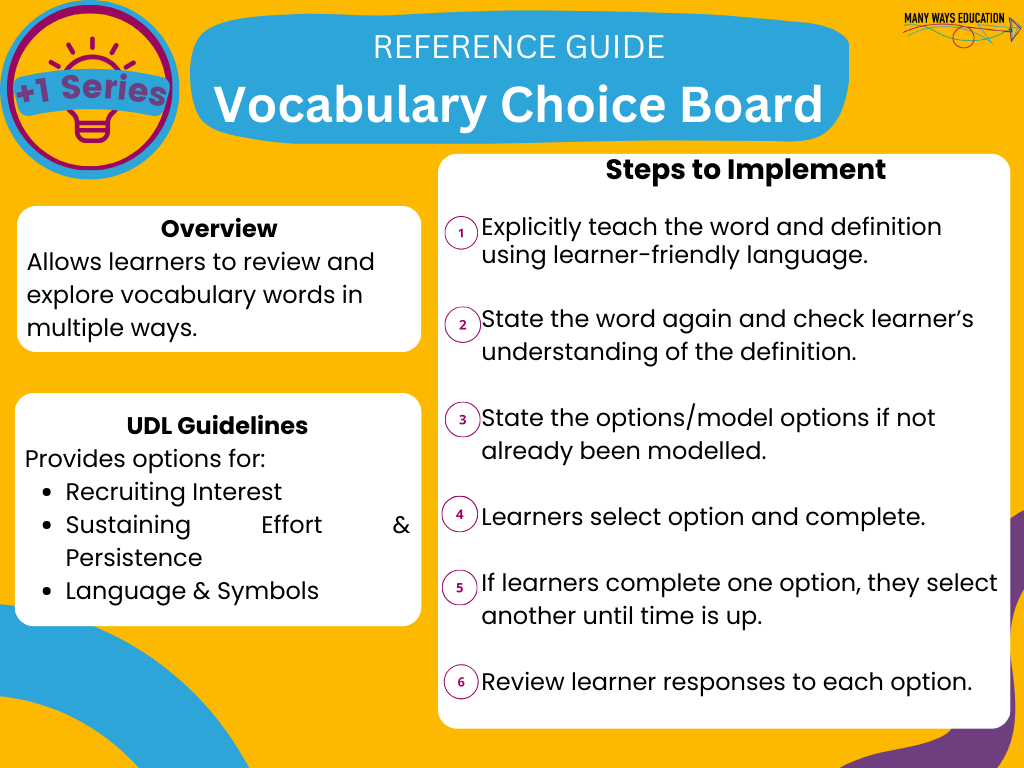
How It Aligns To The Guidelines
Recruiting Interesting
Choice and autonomy supports the development of self-determination (CAST, 2018). By providing the four options to review and explore the focus word, learners can select an option that they perceive to be achievable to them. It also provides learner agency in their own learning. The autonomy in this routine also supports learners who strive for control in the classroom.
Sustaining Effort & Persistence
By providing choices that differ in challenge, learners develop their skills to self-regulate themselves as learners. These options allow learners to determine which option is attainable for them at that time. Each choice is obtainable and the amount of options they select varies the demand also.
Language & Symbols
This routine allows learners to explore words in multiple ways in a way that is meaningful for them.
Example Of Use
This routine can be embedded in your already established vocabulary routine. Once the words have been explicitly taught, the vocabulary choice board can be used as a review the next day of the previously taught words. This routine is intended to be about 15 minutes, depending on the number of words to review. However it is recommended that these are no more than 4-5 words at time. The example below is how it can be used in a year three classroom.
Example
Day 1
1. Teach the focus words by identifying the pronunciation, syllables and phoneme-grapheme relationships of the focus word.
2. Identify the part of speech and other words in the word family.
3. State the learner-friendly definition of the word.
4. Explore visual or physical representations of the word.
5. Have learners use the word in a sentence to check their understanding.
Day 2
1. Review the focus words and their definitions.
2. Present the vocabulary choice board and explain the options.
3. Learners select an option and complete.
4. If finished early, learners select and complete another option.
5. Review learner’s responses.
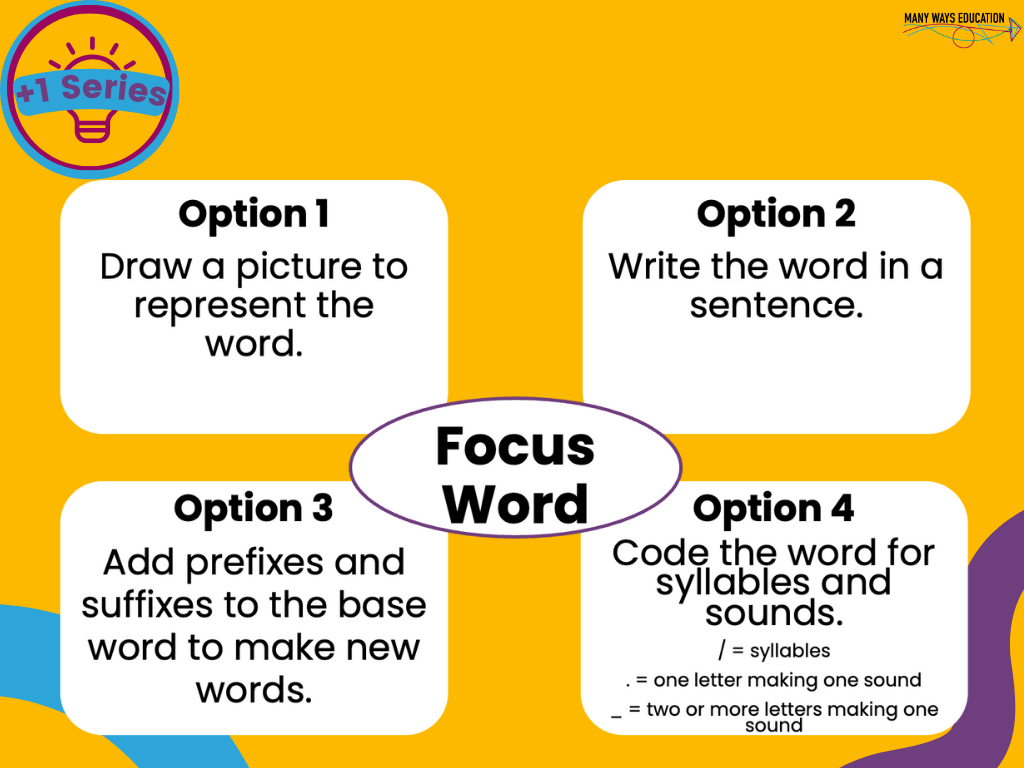
Want to get started straight away? Head over to our Tes Shop and grab a copy of this template for free!
As per usual, this routine should be adapted to meet the needs of your learners but next time you are looking for a different way to review vocabulary words, have a go at this vocabulary choice board. Leave a comment below to tell us how it went. Remember it is about just adding one small change or addition to your instruction.
Until next time,
Happy educating,
Sam
References
CAST. (2018). Checkpoint 7.1 Optimize individual choice and autonomy. The UDL Guidelines. Retrieved March 27, 2024, from https://udlguidelines.cast.org/engagement/recruiting-interest/choice-autonomy
Fisher, D., Frey, N., & Hattie, J. (2016). Visible Learning for Literacy, Grades K-12: Implementing the Practices That Work Best to Accelerate Student Learning. SAGE Publications.
 Many Ways Education
Leave a comment