
How I use visuals to enhance my lesson reflection
In this post you will find:
- A process I use to reflect on my lessons using a visual
- A free resource for you to try yourself!
I’m finding myself more and more using visuals to reflect on my practice. But then again, when I think about it, the way I remember or process information is through visuals. I have to see the layout, the relationships and the big picture in order to understand the information. For me, highlighting patterns, critical features, big ideas and relationships is a big one! That is why I wanted to share with you how I have been reflecting on some of my learning experiences lately.
You guessed it! It’s a visual. Reflection is a learning experience for the educator and it doesn’t matter how long you have been in this game, it is still important to reflect on a lesson or two. In this post I am going to share how I reflect on my learning experiences.
To start the process I have some key questions I ask of myself as I work through my reflection. These include:
- What was the goal of the lesson?
- What did learners do in the lesson?
- What were some barriers I anticipated for learners and how did I design my lesson to overcome those barriers?
- What was the feedback from learners?
- What were some barriers I discovered throughout the lesson?
- How could you redesign the lesson to eliminate those barriers in the future?
Let’s unpack these questions a little more below.
What was the goal of the lesson?
The most important one! The goal is the foundation of good instruction (Meyer et al., 2014). I firstly identify the goal that I wanted my learners to achieve. This way I can determine if the methods and materials I provided helped or hindered learners to achieve the goal.
What did learners do in the lesson?
I then identify the actions that learners did in the lesson. It is important here to note that it isn’t what I did as a teacher but what the learners did. The reason I do this is because it is about the learners and not me. It helps me identify where learners sat too long having to listen to me, too much writing or wait time ect. By focusing on what the learners did, allows me to determine their engagement with the lesson.
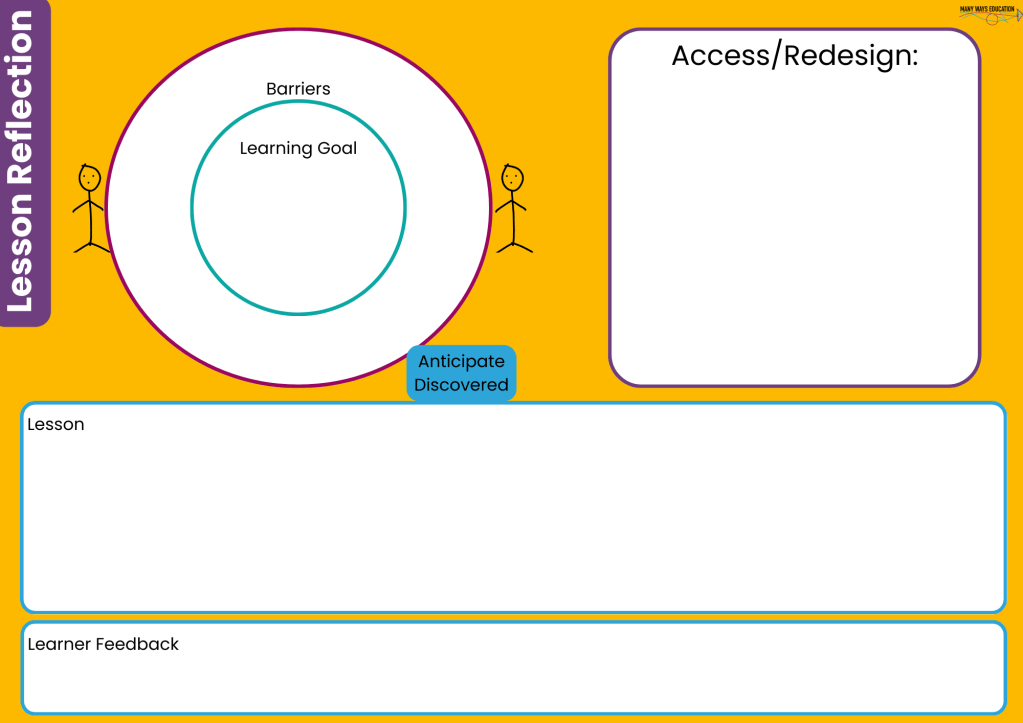
I do this by writing each activity learners did in a square. I learnt this process from journey mapping. It is a great way to work through the activities within a lesson. I have been known to use sticky notes here to identify activities for learners also.
What were some barriers I anticipated for learners and how did I design my lesson to overcome those barriers?
Now that I have my goal and what the learners did in the lesson, I move to identifying the barriers I anticipated. I record them in the barriers circle and highlight where and how I designed my lesson to eliminate those barriers. I do this because I want to remember and acknowledge where I have designed the lesson so that it was more accessible for learners. Also when it comes to redesigning elements of the lesson, I can make sure I am not cutting out the supports I put in place to remove barriers. A follow up question is; were these supports effective in removing barriers for learners?
What was the feedback from learners?
Learner feedback is so important in my reflection process because it is the learner’s learning experience. Here I consider the behaviour and level of success for learners. I consider behaviour because it is communicating a need for my learners. It might be saying that the task was too hard or easy, the learner did not know what to do or they didn’t have the right resources. The level of success is always towards the learning goal. Here I consider who achieved the learning goal and who did not. I then consider why they were not successful at achieving the learning goal. This is where I start to discover barriers.
What were some barriers I discovered throughout the lesson?
From the previous question I start to list other barriers to learning that occurred in the lesson and record them in the barriers circle. I start to unpack them in terms of what the barrier was and how it can be overcome in future lessons. I keep working through the feedback from learners until I am satisfied with knowing I have identified all the barriers. You will never identify all the barriers but it is about progress.
How could you redesign the lesson to eliminate those barriers in the future?
I then consider how I might redesign lessons or make adjustments in my instructional routines in the future that eliminate the barriers I have discovered. Here I might highlight in the lesson section where I might redesign that part of the lesson or I might just list them for future reference. I find when I plan them into the lesson section, there and then, I have more success.
So there it is. How I use a visual to reflect on my instruction. Grab a copy of the visual I use. It comes with the key questions and it steps out the process for you as you go.
Using visuals to reflect has been a game changer for me. Have a go at using the graphic next time you are reflecting on a lesson and let me know what you think.
Until next time
Happy educating
Sam
References
Meyer, A., Rose, D. H., & Gordon, D. (2014). Universal Design for Learning: Theory and Practice. CAST, Incorporated.
 Many Ways Education
Leave a comment