
In this post you will find:
- a routine that can be used to provide opportunities for learners to explain their learning
- an example of how to you this routine
- a free template for the routine
A strategy that is talked a lot about in professional learning for UDL is the notion of plus one. This means that as educators, the intention is to not over haul our pedagogy to implement UDL but just make small changes over time. In this series we are going to provide examples of small routines that demonstrate the UDL principles and that could easily be implemented in lessons tomorrow. So let’s take a look at a partner learning routine.

I’m a big fan of having students work in pairs to solve problems and learn new concepts and skills. It provides learners an opportunity to talk through their learning with others. However sometimes I find that one learner is doing all the work. So it is important that partner work is accountable. There are lots of great ways to make learners accountable in their partner work however I find this one to be simple and easy to implement in any lesson.
What It Is
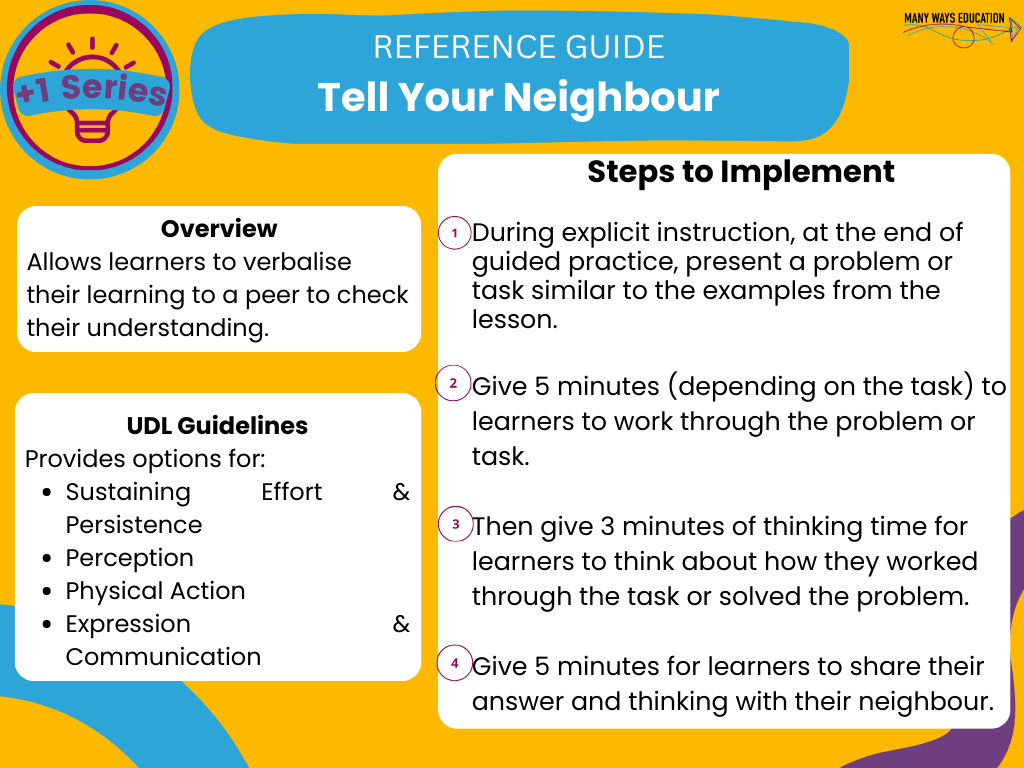
This routine allows learners to verbalise their thinking and learning to a peer as well as allowing them to hear the learning of others. In telling your neighbour learners are first given a problem to solve. They have a set amount of time to solve the problem. This depends on the problem or task of course. Then learners are given time to think about how they solved the problem. They can do this by drawing/diagram, writing or thinking in their heads. This is silent time. Then learners turn to their neighbour and tell them their answer and how they solved the problem.
Opportunities for Differentiation
During the working and thinking time, there is opportunity to work with learners who still require extra support. You can also provide a challenge question for those learners who need extension.
How It Works
Here is an example in a Year Three Maths lesson.
After the explicit teaching of time problems where learners need to identify the end time of an event based on the start time and the duration, learners are given a similar problem to solve. They have 5 minutes of silent working time to solve the problem themselves. Once the working time is up, learners have 3 minutes of thinking time to think about how they solved the problem. They draw a diagram like was modeled in the explicit lesson, write down their explanation or just think it through in their heads. Then they are given 5 minutes to tell their neighbour the answer and how they solved it. Teacher walks around listening to explanations and checking for understanding.
Alignment to UDL
Physical Action
This routine allows learners to engage with the problem through solving it, using metacognition to explain how they solved it and then to verbalise that metacognition to someone else to understand.
Expression and Communication
This routine is best suited at the end of guided practice in a gradual release model. That way learners have an opportunity to see examples and be guided through similar problems before then trying one themself and explaining the steps they took to solve or work through it. This is also a great routine to pair with our independent practice routine. Tell Your Neighbour is a great opportunity for learners to gauge how they are going in their learning ready to make a choice for independent practice.
Perception
Tell Your Neighbour also provides an opportunity for learners who have not quite “got it” yet to hear how their peers have worked through the problem or task. This provides another demonstration for those learners.
Sustaining Effort & Persistence
It is also a great way to have learners collaborate on a task and provide feedback to each other. At this point in the learning experience, chances are learners have not had a chance to speak so this is a great routine to ensure that learners have an opportunity to talk about their own learning and hear about others’.
This routine can be implemented in any lesson or learning experience. Why not give it a try in your next lesson? Grab your free template at our Tes Shop below?
If you do try it, let us know how it goes.
Until next time,
Happy educating,
Sam
 Many Ways Education
Leave a comment