Tag: student variability

8 No Prep Ways to Provide Choice in Any Lesson

8 No Prep Ways to Provide Choice in Any Lesson

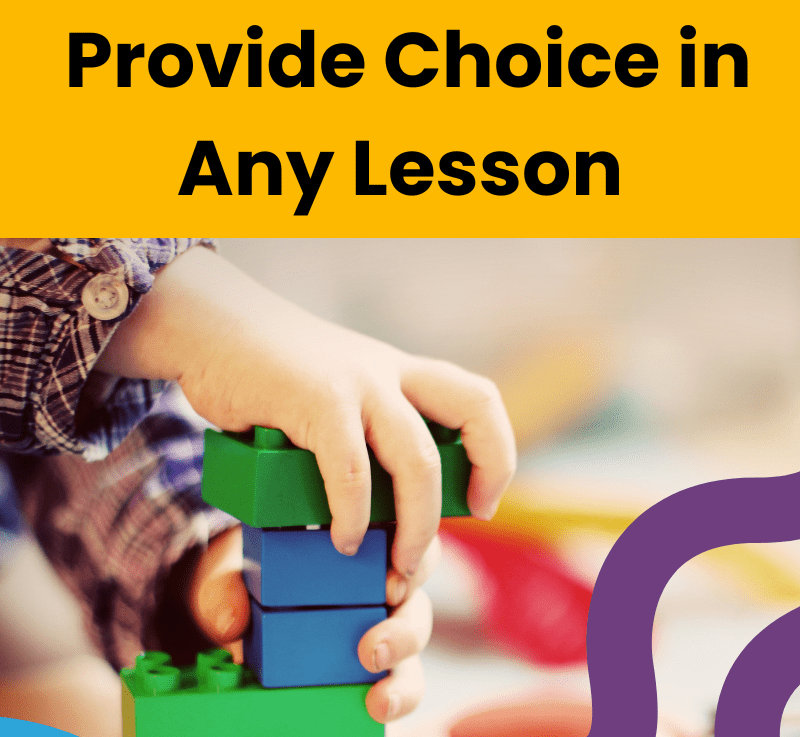
Why not start small? Providing choices for learners does not have to be extravagant projects or tasks such as choice boards. It can also be the small, simple options we give our learners between projects and tasks. They can be as simple as allowing learners to make a choice about where they sit in the lesson or how they interact when answering a question. These simple choices provide snippets of autonomy for learners and are designed in a way that allows learners to see that they will be successful in at least one of the options.
+1 Series: Small Routines with Big Impact: Learning Goal

+1 Series: Small Routines with Big Impact: Learning Goal

A clear goal is the very foundation of effective curriculum (Meyer, Rose, & Gordon, 2014). Why not represent the learning goal in multiple ways for learners? This routine supports learners to know and have a clear example of what they will be able to do by the end of the lesson as well as representing the learning goal in many ways.

+1 Series: Small Routines with Big Impact: Vocabulary Choice Board

+1 Series: Small Routines with Big Impact: Vocabulary Choice Board

We all know how important vocabulary is to reading comprehension and the importance of teaching vocabulary explicitly (Fisher et al., 2016). This routine is used after the explicit teaching of vocabulary. This routine allows learners to review and apply their understanding of the focus word in different ways.

UDL: The Hope For The Future

UDL: The Hope For The Future

When children are young we embrace their individuality and celebrate it but then when they go to school something happens. We start to put our children in boxes of who’s achieving and who’s not or the behaviour kids and the pleasure to teach kids. If they don’t fit in any of those boxes we don’t know what to do with them. We lose sight of the fact that our students are children and they are all different.

Four BIG Reasons Why You Should Use Multiple Means in Your Lessons 

Four BIG Reasons Why You Should Use Multiple Means in Your Lessons 

The goal of this post: Explain why flexibility and choice created by multiple means is important in your classroom Key ideas: By providing multiple means you are catering for diversity in learners, developing expert learners, being more present in lessons and allowing students to achieve success Introduction If you are an UDL fan like me, … Continue reading Four BIG Reasons Why You Should Use Multiple Means in Your Lessons