
Goals of this post:
- Understand what construct relevance is
- A process to ensure integrity while keeping flexible means when planning for assessment
Key ideas:
- Always refer back to the standard when considering if a task will
Terms you might need to know for this post:
Achievement standard – what is assessed in the Australian curriculum
Content description- aligns to the achievement standard but is what is taught
The Australian Curriculum states that it is developed with the UDL principles in mind. It is clear when you explore the achievement standards and content descriptions that there is flexibility in the interpretation. Therefore assessment tasks will look different in every school. However, how do we provide flexibility within schools when we know that there is variability in every class? How do we ensure that we have the flexibility but keep the rigour of the assessment?
Construct Relevance
Construct relevance is the idea that we are assessing the skills and concepts that we say we are assessing and not the means. The goal of assessment is to find out if students can demonstrate the skill or knowledge of a concept. However sometimes the way we have students demonstrate their learning is the barrier.
Here is a great explanation from the guys at CAST.
It all sounds good but how do we get clear on the expectations and limitations for an achievement standard and how does a school get on the same page?
Try This!
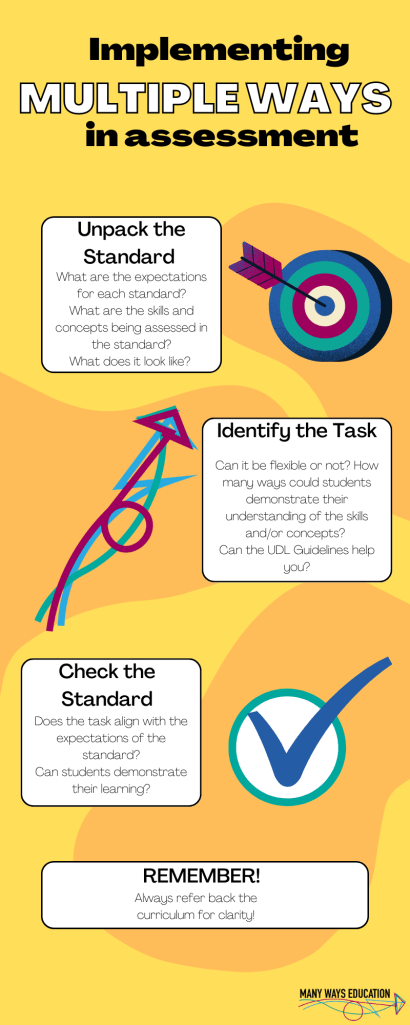
- Unpack the standard to identify construct relevance by pulling out the skills and concepts being assessed and discuss what they might look like for the particular year level. Refer back to the Australian curriculum… always.
- Identify the task- can it be flexible or not? Sometimes tasks can’t be as flexible. However, the tools we provide students to achieve the task can be. If it is flexible, how many ways can it be flexible? Can the UDL guidelines help you here?
- Refer back to the standard to check to see if the task you have identified still aligns to the expectations of the standard.
Have a Go!
Next time you are planning assessment, try this process with your team and see if you can provide multiple means in assessment while keeping consistent expectations.
 Many Ways Education
One thought on “How to Create Multiple Means in Assessment”