
The goals of the post:
- Identify the components of a lesson goal.
- Explain a process for creating lesson goals that include all learners.
Key ideas:
- Lessons that include all learners are derived from the standard, relevant and meaningful for learners, flexible in means, challenging for all and are shared with learners.
Have you ever had a lesson where you are so excited to teach because you thought that it will be an awesome lesson? You think to yourself: everyone will enjoy it as much as you only to deliver it and have some students bored and others overwhelmed? Finally, when the whirlwind of a lesson finishes, you fall in a heap in the nearest chair and wonder what just happened? You started the lesson excited and hopeful and now you are flabbergasted. So, what just happened?
One of the biggest challenges for teachers is to develop lesson goals that are inclusive of all students. UDL ensures that all learners are included at the start by being proactive at the planning stage. It is important to keep the expectations high and support learners to reach them through options and support. The way we enact this with UDL is to ensure that every lesson has a goal that is derived from the curriculum standards. However, the challenge is to ensure that the lesson goal is written in a way that supports access for all our learners. So how do we create lesson goals that include all learners?
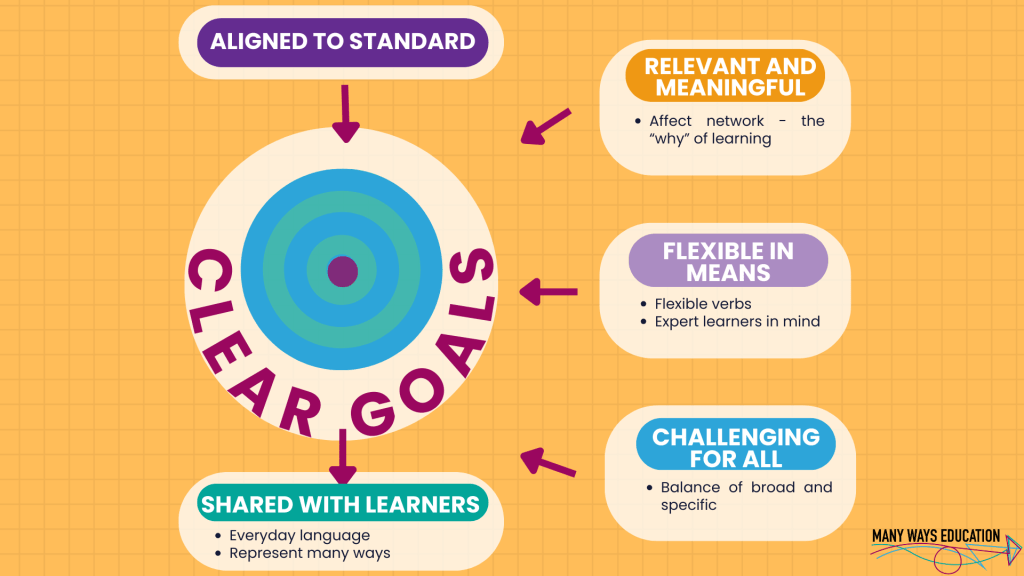
There are six key components of a learning goal that includes all learners. They include ensuring the goal is aligned to the standard, is clear, relevant, and meaningful to learners and is flexible in means. It also needs to challenge all learners. It may sound like a lot, but they are simple once you know what they are and how to do them. Let’s start to unpack them.
Aligns to the Standard
A lesson goal should identify the knowledge, skills and dispositions required from the curriculum standard. There should be clear alignment between the standard and the lesson goal. We do this by unpacking the curriculum standard.
Clear Goals
Clear goals are the foundation of any lesson, and this is the same for UDL. A clear learning goal is the foundation to effective curriculum for all learners. It is also a clear path for both teacher and learners. Once there is clarity of the lesson goal, specific methods and materials can be identified. Let’s be clear :P. The goal is not the activity. The goal identifies what knowledge, skills or attitudes or beliefs learners require to achieve success in the lesson. Only after you have identified the goal, activities can be identified. It is suggested in many readings that clear goals are SMART goals:
S = specific about the knowledge and skills learners need
M = measurable with evidence
A = attainable by all learners
R = results-oriented
T = time bound
Relevant and Meaningful
Ever had to learn something that you did not see the relevance? Relevant and meaningful goals support the affective network of the brain, therefore improving the engagement of our learners (Meyer, Rose & Gordon, 2014). When we create a lesson goal, we should always ask how is the goal relevant to our learners? Why should they care about learning this? How does it connect to or impact their lives or communities?
Flexible in Means
A good lesson goal is flexible in the way it is written to acknowledge variability (Meyer, Rose & Gordon, 2014). It is important that we identify the goal from the means in which learners demonstrate the goal. To do this, we can identify if the verb in the goal is restrictive or flexible (Relabate & Lord Nelson, 2017; Torres & Rao, 2019). This will give us an understanding of how flexible our goal is.
Restrictive verbs such as “write” restrict how learners can demonstrate their understanding of the goal. If we swapped “write” for a flexible verb like “compose” we bring in flexible means for learners to demonstrate their learning. When our goals are flexible in nature, our methods and materials can be too. However, there are times that we need to use a restrictive verb because the standard requires it. In this case we build in flexible through the scaffolds and supports we provide learners to achieve the restrictive goal.
By providing flexible goals, we are also promoting expert learning. Through choice and options, learners can select pathways that support them to achieve the lesson goal.
Challenging for All
Our lesson goals should be written in a way that are challenging for all learners. Sounds challenging hey? No not really. Usually, we find that when we are too specific in the lesson goal, we develop barriers for some students. Sometimes we have to be specific and that is ok however we should always go back the standard or, even here in Australia, going to the related content descriptions, to check that we have not put something in that isn’t there therefore developing barriers that we don’t need to.
Share it with Learners
Once we have created the lesson goal, is it important that we share it with our learners in language that they understand. This also helps promote motivation, self-regulation, and executive functions (Ralabate, 2016) therefore expert learning. We should share the goal multiple ways, so we ensure that it is understood by all learners. This is also a great opportunity for learners to express to you any barriers they might encounter throughout the lesson.
A Process
So now you know the components of a lesson goal, let’s have a look at a worked example.
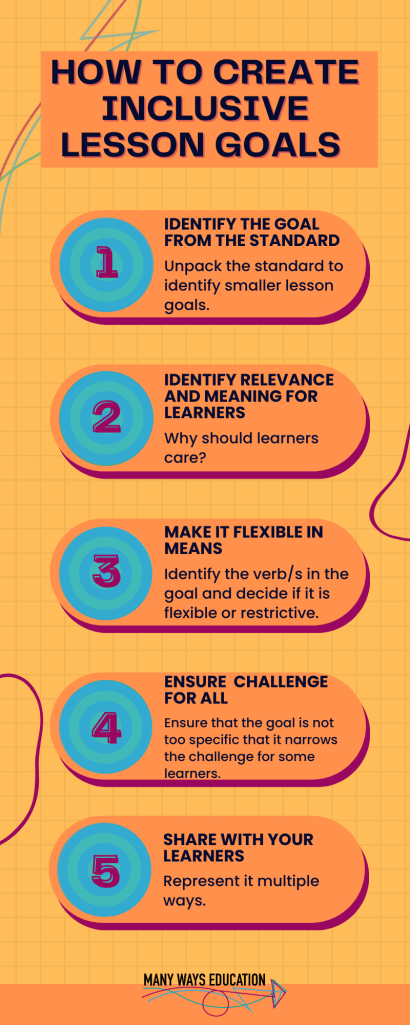
Here is a process we can go through to create a lesson goal that include all students.
1. Identify the goal from the standard
First things first, we need to unpack the standard to identify a progression of learning that ultimately is the list of lesson goals from the standard. Not sure how to do it? Click here.
For Example…
I have identified a Maths standard, from The Australian Curriculum, for Year Three;
Students find unknown values in number sentences involving addition and subtraction (ACARA, 2023).
From here I have identified the skills and the concepts required to achieve the standard. Please note that in Australia we also have the content descriptions that give us more information about the standard, so I have identified the skills and concepts in them also. I have created a progression of learning and have identified that: Recognise and explain the connection between addition and subtraction as inverse operations as a lesson goal
2. Identify relevance and meaning for the learners
Next, we need to ensure that the goal is or can be relevant to our learners. Remember we need to include the affect network of their brains for engagement also, what it the point of learning something that is not relevant to us?
For example…
I have identified that for the learning goal; Recognise and explain the connection between addition and subtraction as inverse operations learners need to know this to help them with money and this week, over Australia, children have been dressing up for book week. When Book Week is on a lot of schools have a book fair where students can buy books. It is very exciting for students. So, it is important for my learners to understand such things as giving and receiving change or deciding how much more money they need to buy a book they would like. We could go to the fair and investigate the books for this to help us.
| Lesson Goal | Relevant and Meaningful |
| Recognise and explain the connection between addition and subtraction as inverse operations | Book week: – Working out how much money you have left after you buy something – When you are saving to work out how much money you need to buy a book – Receiving change |
3. Make it flexible in means
Thirdly we need to identify the verb/s in our goal and decide if it is flexible or restrictive. If it is restrictive, that’s ok, we can add in supports that support our learners, but we do need to check the standard to see if we have not put in a restrictive verb when it is not required. If the verb is flexible, we are able to brainstorm ways learners could demonstrate the verb.
For example…
I have identified the verbs “recognise” and ” explain” as flexible verbs because learners can demonstrate those verbs multiple ways.
| Lesson Goal | Flexible or Support |
| Recognise and explain the connection between addition and subtraction as inverse operations | Recognise: – Sort/group – Point out – Highlight Explain: – Written – Orally – Diagram -Demonstration |
4. Ensure it is Challenging for All
We need to ensure that the goal caters for challenge at all levels. We need to ensure that the goal is specific but not too specific that it narrows the challenge for some learners.
For example…
I have ensured that the goal does not specify the challenge in the goal but in the means. Here I have identified that challenge could occur in the number of fact families learners recognise as well as the different representations they could recognise and explain. Again, I have checked the standard. In this standard, they need to use number sentences however this lesson goal is the first in a learning progression to achieve the standard and I have chosen not to include number sentences in this goal at this time.
| Lesson Goal | Challenging |
| Recognise and explain the connection between addition and subtraction as inverse operations | – number of fact families – challenge in how learners recognise and explain – word problems vs. concrete vs. diagrams such as part-part-whole tables |
5. Share with Your Learners
Don’t forget to share your lesson goal with your learners and represent it multiple ways.
So here is what the creation of your goal might look like in a table form:
| Lesson Goal | Relevant and Meaningful | Flexible or Support | Challenging |
| Recognise and explain the connection between addition and subtraction as inverse operations | Book week: – Working out how much money you have left after you buy something – When you are saving to work out how much money you need to buy a book – Receiving change | Recognise: – Sort/group – Point out – Highlight Explain: – Written – Orally – Diagram -Demonstration | – number of fact families – challenge in how learners recognise and explain – word problems vs. concrete vs. diagrams such as part-part-whole tables |
Try This…
Have a go at creating your own lesson goals using the process above or reflect on the goals you have already created to see if they are relevant and meaningful, flexible in means, and challenging for all. How do you create lesson goals that include all learners?
Until next time,
Happy educating,
Sam
3 responses to “How to Create Lesson Goals that Include All Learners”
-

[…] to dictate the means in our learning goal. For more information about writing a learning goal read this post. When we leave the means out of the learning goal, we have already provided flexibility and […]
LikeLike
-
[…] identify the skill and concept learners need to demonstrate the learning. Check out our post about creating inclusive learning goals. Without the learning goal, the choices we design may not allow learners to demonstrate their […]
LikeLike
-
[…] flexible goals, which means no more designing two or three mini-lessons in one. The focus shifts to inclusive goals, allowing students to achieve the same outcome in different ways. This saves you planning time […]
LikeLike
References
CAST (2020). UDL Tips for Developing Learning Goals. Wakefield, MA: Author. Retrieved from https://www.cast.org/products-services/resources/2020/udl-tips-developing-learning-goals
Meyer, A., Rose, D., & Gordon, D. (2014). Universal Design for Learning: Theory and Practice. Wakefield, MA: CAST.
Posey, A., & Novak, K. (2020). Unlearning Changing Your Beliefs and Your Classroom with UDL. CAST, Inc
Ralabate, P. (2016). Your UDL Lesson Planner: The Step-by-Step Guide for Teaching all Learners. Paul H. Brookes Publishing Co.
Ralabate, P., & Lord Nelson, L. (2017). Culturally Responsive Design for English Learners: The UDL Approach. CAST, Inc
Torres, C., & Rao, K. (2019). UDL For Language Learners. CAST. Inc
 Many Ways Education

Leave a reply to Why You Will Love Universal Design for Learning (UDL) – Many Ways Education Cancel reply