
In this post you will find…
- Four misconceptions addressed to move your thinking about UDL forward
- An infographic
- A video representation
Mind traps are like sand traps in golf. In golf you don’t want your ball to land in the sand on the course because it is hard to get it out. You usually have to have a few hard hits in order to get the ball out of the sand trap.
Mind traps like sand traps are hard to get out of because they are a way of thinking that stops us from moving forward in our learning and practice. These UDL mind traps are misconceptions that teachers have about UDL and they find it hard to move into UDL practice without them being addressed.
So lets have a look at 4 mind traps and address them.
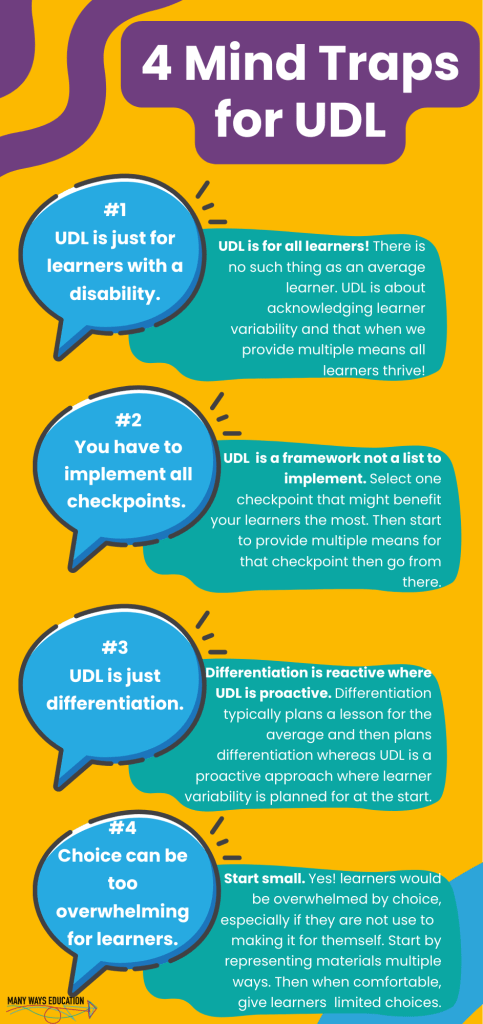
Number one – UDL is just for learners with a disability
UDL is for all learners. UDL recognises learner variability. Our experiences, skills and abilities differ from each other whether we have a disability or not. There is no average learner and UDL celebrates this about humankind. We can provide options and choices in our learning experiences to support all our learners in achieving success.
Number two – You have to implement all the checkpoint of the UDL Framework in order to be implementing UDL
If we tried to implement all of the checkpoints on the framework in one lesson, we would lose our minds! The framework is not intended to be a checklist but just that; a framework. We use it as a lens to look over our practices. We select checkpoints that are relevant for our learners and context. When you think about it the framework is layered. Start with one or two checkpoints that are relevant for you and just implement those checkpoints one way. Then try providing multiple means for those same checkpoints. We can use the framework in different ways, but not all at once.
Number three – UDL is just differentiation
Differentiation is typically reactive in nature because a lesson is usually planned based on an average learner and then differentiation is planned for the learners on the edges. Whereas UDL is proactive. It plans for variability from the start. There can be differentiation in a UDL. Check out checkpoint 8.2!
Number four – Too much choice can overwhelm learners
Start small. Absolutely learners can become overwhelmed by choice. Especially if they have not had the opportunity to make choices about their learning in the past. To start with, just provide multiple ways to represent the information for a lesson. This could be through visual diagrams and you speaking or provide a video. Then offer learners two choices once you have taught them how to make a good choice and how to do those two choices. Then build up from there but take it slow. Its not about providing as many choices as possible, it is about providing high quality and effective choices that reach as many learners as possible.
So there you have it. Four mind traps that educators can get trapped in when exploring UDL.
Until next time,
happy educating,
Sam
 Many Ways Education
Nice one!.
This is what I found out in your post
Great article! It addresses common misconceptions about UDL and provides helpful insights. Keep up the good work!
Ely
LikeLiked by 1 person