
In this post you will find:
- What the independent practice routine is
- How it aligns to the UDL Guidelines
- An example of how it can be used
A strategy that is talked a lot about in professional learning for UDL is the notion of plus one. This means that as educators, the intention is to not overhaul our pedagogy to implement UDL but just make small changes over time. In this series, we are going to provide examples of small routines that demonstrate the UDL principles and that could easily be implemented in learning spaces tomorrow. So let’s take a look at an independent practice routine.
What It Is
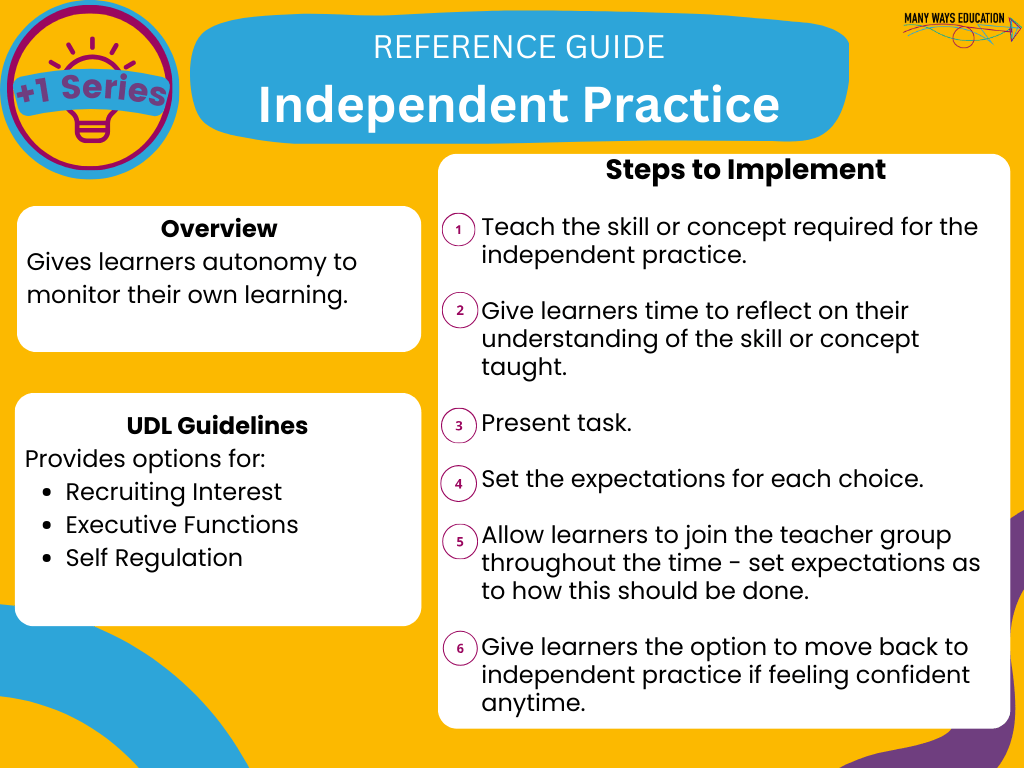
This routine is very simple yet so effective! We all know those learners who need a bit more support or a confidence boost to get them on their way for independent practice of a skill or concept taught. This routine gives learners the autonomy to decide if they are ready for independent practice or not. The goal of UDL is to develop expert learners and this routine supports learners on their journey to becoming an expert learner. This routine is simply giving learners a choice to carry out the independent practice by themselves or utilise the teacher more.
How It Aligns To The Guidelines
Recruiting Interest
This routine empowers the learner to control their learning. This empowerment develops self-determination and an increased connection to their learning (CAST, 2018). When learners have a choice in how they will complete their independent practice, they are developing their skills in becoming expert learners.
Executive Functions
By providing choice in this routine, learners are honing their skills to monitor their progress and modify their strategies in achieving the learning goal in a simple way. They are making the choice to utilise the teacher to help improve their progress towards the learning goal or practice their understanding of the learning goal. By providing a few moments for learners to reflect on their progress in the lesson, they are able to select a strategy that best suits them moving forward.
Self Regulation
This routine promotes to learners that they are capable of making decisions about their learning and progress. By scaffolding the reflection before learners make a choice, provides an explicit model of what expert learners do.
An Example
After an explicit lesson on telling time in 5 minute intervals, learners move to an independent practice where they are to match the analogue clock times with the digital. The teacher has modeled how to count around the clock to identify how many minutes past or to and learners have participated in partner work to complete the same task.
The teacher hands out a sticky note and asks learners to decide where they are on the emoji scale as to how they are feeling at this point of time in the lesson. She then discusses how the way learners might be feeling might help them make a choice about how they work in the independent practice.
The teacher presents the task to the learners and then the options. The class goes through the expectations of each option and learners make a choice. The teacher uses a countdown timer for one minute to allow learners to make a choice and organise themselves for the option they have selected. When the timer goes off, learners are completing the task the way they selected. The teacher monitors the class and then starts working with the learners on the carpet, questioning and scaffolding the learning.
Want to have a go at this simple, yet effective plus one routine? Grab the template from our Tes Shop!
What a simple yet powerful way to have learners take control of their learning? Have a go at this routine and let us know how it goes in the comments below. Remember:
Until next time,
Happy educating,
Sam
References
CAST. (2018). Checkpoint 7.1 Optimize individual choice and autonomy. The UDL Guidelines. Retrieved April 4, 2024, from https://udlguidelines.cast.org/engagement/recruiting-interest/choice-autonomy
One response to “+1 Series: Small Routines with Big Impact: Independent Practice”
-

[…] the steps they took to solve or work through it. This is also a great routine to pair with our independent practice routine. Tell Your Neighbour is a great opportunity for learners to gauge how they are going in their […]
LikeLike
 Many Ways Education
Leave a comment