
In this post you will find:
- Explanation as to why choice is important
- 8 no prep ways you provide choice in your lessons
Imagine leaving a lesson where you feel exhilarated and successful as a teacher. You feel that every learner was engaged in the learning. You had high levels of participation and everyone was successful at achieving the goal of the learning experience. What did you do in the lesson to achieve this feeling of accomplishment?
What were the instructional decisions you made in the learning experience that allowed you to have success as a teacher? Did you provide choice so learners felt like they had some control of their learning? Did you remove barriers from the learning because you gave them a choice?
When we consider engagement, unfortunately there is no one way to engage every learner (CAST, 2018). However we can promote engagement for every learner by providing choices that they can select within the learning experience. To increase engagement with choice, learners must feel like they have some autonomy in their learning and that the choices provided to them are perceived by the learner to be choices that the learner can be successful in (Parker, Novak & Bartell, 2017). We also know that providing choice can remove barriers for our learners (CAST, 2018). Providing choice is one way to increase engagement in any learning experience.
However if you are new to UDL or even on the journey, providing choice can feel overwhelming. It can take careful thought and preparation to ensure that learners are successful with the choices you provide.
So why not start off small?
Providing choices for learners does not have to be extravagant projects or tasks such as choice boards. It can also be the small, simple options we give our learners between projects and tasks. They can be as simple as allowing learners to make a choice about where they sit in the lesson or how they interact when answering a question. These simple choices provide snippets of autonomy for learners and are designed in a way that allows learners to see that they will be successful in at least one of the options.
So here are nine ways to provide choice in any lesson that requires no prep. Give them a go!
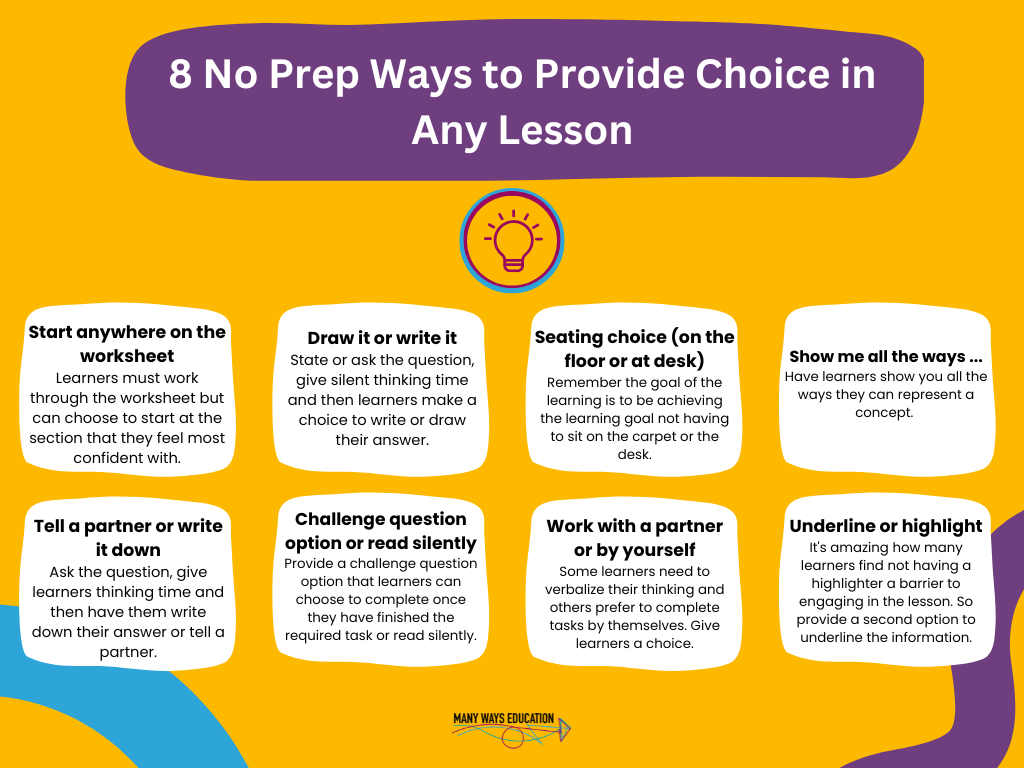
Start anywhere on the worksheet
In my experience most learners just find it hard to start. This works well when the worksheet is providing multiple ways to engage with the concept being taught. Learners must work through the worksheet but can select the section that they feel most confident with and then the next and so on.
Tell a partner or write it down
Want more participation when you ask a question? Ask the question, give learners thinking time and then have them write down their answer or tell a partner.
Draw it or write it
This one also works to increase participation when asking a question or recalling information taught. It is the same process. State or ask the question, give silent thinking time and then learners make a choice. This one works well when the class is required to be calm and quiet.
Challenge question option or read silently
Provide a challenge question option that learners can choose to complete once they have finished the required task. Remember this question is optional. If they do not wish to answer they read silently until time is up.
Seating choice (on the floor or at desk)
Why not let learners select where they sit for the instruction? Some learners appreciate staying at their desks in their space while others like to sit on the floor. Remember the goal of the learning is to be achieving the learning goal not having to sit on the carpet or the desk.
Work with a partner or by yourself
Some learners need to verbalize their thinking and others prefer to complete tasks by themselves. Give learners a choice. You may need to set expectations around whispering to your partner and allocate a space in the room to work so they are not disrupting the independent learners but worth it.
Show me all the ways …
Want to check for understanding? Have learners show you all the ways they can represent a concept. This task allows all learners to access and demonstrate their understanding of a concept their own way.
Underline or highlight
At times we find that our learners do not come to class with the right tools. When unpacking texts and locating information why not just simply ask learners to underline with a pen or pencil, or highlight. It’s amazing how many learners find not having a highlighter a barrier to engaging in the lesson. So provide a second option to underline the information. The end result is the same.
Next time you are planning a learning experience, why not try some of these strategies to provide more choice while not overwhelming yourself. Notice how learner engagement increases just by using these small simple strategies.
Until next time,
Happy educating,
Sam
References
CAST (2018). Universal Design for Learning Guidelines version 2.2. Retrieved from http://udlguidelines.cast.org
Parker, F., Novak, J, & Bartell, T. (2017). To engage students, give them meaningful choices in the classroom. Phi Delta Kappan 99 (2), 37-41.
 Many Ways Education
Leave a comment