
In this post, you will find:
- ideas, tools and strategies that you could use to support all learners in writing
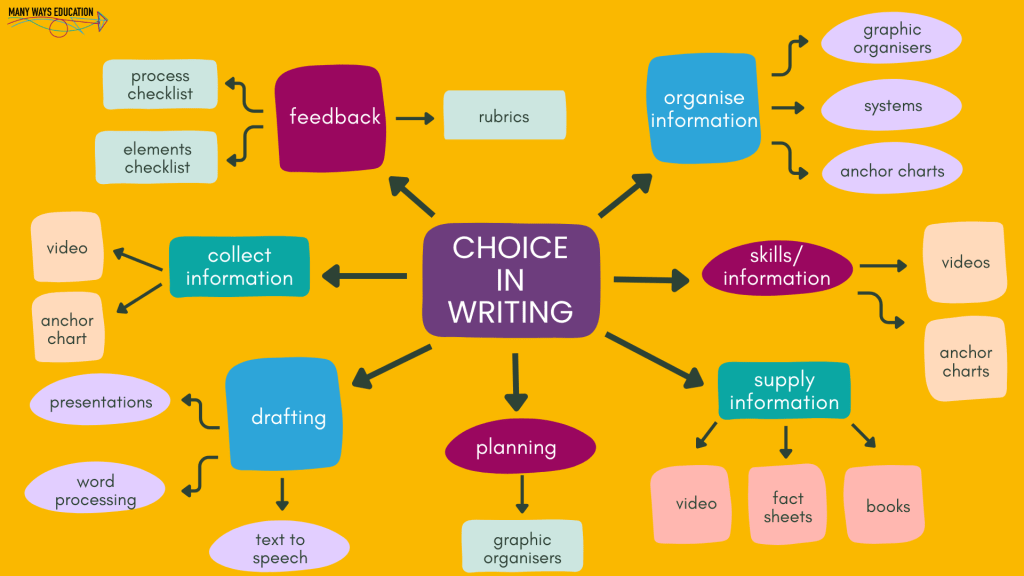
- a visual of the ideas, tools and strategies that you can download
Writing is a complex skill that many people find challenging to master, especially when faced with barriers that hinder learning the foundational skills needed to write.
Imagine a classroom where every learner proudly sees themselves as a writer, unencumbered by barriers. They understand that it doesn’t matter if they are still learning to spell difficult words or find structuring paragraphs confusing, because they have tools and resources that help them become good writers.
Writing lessons often pose challenges for both educators and students, sparking anxiety and frustration. Learners feel anxious due to the numerous skills required to master writing a well-structured text, while educators struggle to effectively reach each student at their individual learning levels.
What if we could transform this struggle into a strength? Imagine a classroom where learners are engaged and independent, confidently using resources and tools when they need them and actively participating in their learning, creating a vibrant and productive learning environment. Picture learners deeply engaged in the learning they need, with educators working alongside them to provide feedback on writing, and learners understanding exactly what steps to take next.
Consider implementing these dynamic strategies to transform your classroom into a lively hub of engaged writing activity:
Short Videos
Provide short videos for the information or skills learners need.
Harness the power of modern technology by creating captivating videos using tools like PowerPoint or Canva. Record lessons on paragraph writing or text structuring and store them in a class notebook or your school’s learning platform. Learners can refer back to these videos whenever they need, allowing them to pause and rewind as necessary, freeing up your time from re-teaching.
Multiple Modes
Provide different modes for supplying information.
When writing an informational text, offer a variety of resources—videos, fact sheets, and engaging books—that students can explore to collect information. This approach can also be effective for persuasive and procedural texts.
Provide Tools and Strategies…
…to Collect Information
Create a lesson on highlighting and note-taking and record it as a video. Then, create an anchor chart as a visual reminder. Additionally, make a video on how to colour-code information.
…to Organise Information
Provide various methods for organising information, such as graphic organisers, colour-coding systems, and tools. These resources can help free up working memory, allowing learners to focus on the writing itself. Don’t forget to provide anchor charts to help learners remember processes and systems.
…to Plan for Writing
Model different graphic organisers for planning paragraphs and texts. Allow learners to experiment with all of them to find the one that best suits them. It’s important to also model how to use the graphic organiser for writing, especially for younger learners who might just rewrite the organiser.
…to Draft
Do learners need to handwrite all the time? Offer tools such as word processing, PowerPoint, and text-to-speech software to assist them in drafting their writing. Our learners will need to use these tools in the real world, so why not support them in learning how to use them now?
…to Reflect and Receive Feedback
Provide checklists for the writing process or elements required for particular text types. Convert these checklists into comprehensive rubrics that can be used by educators or peers for feedback. These checklists and rubrics can also help learners reflect on their progress, serving as valuable tools for feedback and reflection.
By implementing these strategies, educators can create a supportive and dynamic learning environment where learners feel empowered to develop their writing skills. Providing diverse resources and tools allows learners to take ownership of their learning, fostering expert learners. As learners become more confident writers, they are better equipped to express their ideas clearly and effectively, setting them up for success in both academic and real-world contexts.
Transform your classroom into a thriving center of engaged learning by integrating these writing strategies today. Why not check out our “Preparing for Writing Resource Pack for Information Texts”? Encourage your learners to explore different tools and resources, and watch as their confidence and writing abilities flourish. Let’s create classrooms where every learner sees themselves as a capable and inspired writer!
Until next time,
Happy educating,
Sam
 Many Ways Education
Leave a comment